No One Is Getting Left Behind This Time
On standing with kids, amplifying their voices, and repairing the harm we've done to their trust in us

“The world’s most resilient forest has a canopy
thick with truth, old oaks with glowing bright barks.
It is grown from seeds of light as a gesture towards hope.
And the people that nurture it carry its seeds far.
Their journey is not easy, but it is as necessary as these seeds.
They plant them in lands with troubled nights and needs.
They are carriers of justice and an infinite dream,
where a better, kinder world is every child’s right
not an impossibility.”
~Nikita Gill
In a 2019 essay for The New Republic on youth activism, Liza Featherstone notes that “Western society is acutely conflicted about kids.” She goes on to explain that we tend to simultaneously invest our perception of children with a unique moral purity, while also often sidelining or actively dismissing their voices. The fact that we tend to view the adult political realm as inherently and inevitably messy and morally fraught, combined with the way we have culturally separated childhood from adulthood, tends to lead us to relegate children’s voices to the periphery on the premise that they are too innocent and naive to be legitimate contributors to the mucky, compromising work of practical change, and at the same time that they are entitled to a childhood free from the need to shoulder the grim responsibilities of the world. We put children and childhood as a whole on a pedestal, but then use the fact of the pedestal we’ve erected as an explanation for silencing them.
Of course, children are rarely fooled by this trap of praise one one side and punishment on the other. Throughout history, as Featherstone reminds us, children and teens have consistently been at the forefront of some of the most important social and political movements. It is often their involvement that ultimately prompts the most pivotal moral reckonings. The adult world both rebukes and relies upon the courage of children.
As such, despite routinely silencing young voices, adults are also often quick to critique a lack of youth involvement the moment there is any lull in engagement with issues that require more widespread participation or social pressure, whether blaming young people for low voter turn-out or for insufficient protest in times when we find ourselves longing for dramatic change. In these moments, adults suddenly miss the same voices they previously decried and downplayed, while rarely taking responsibility for having been the ones to enforce generational silence. Is it any wonder young people become exasperated with adults? Perhaps it’s not just the changing hormones and neuron patterns of their developing brains, but also their accurate assessment of the many contradictory expectations adults often heap on them.
One of the most common refrains young leaders and activists share is a feeling that adults have failed them and, more specifically, that adults have failed to protect the future they will inherit—that their voices are necessary because we have not met the challenges that will shape their lives. From climate change to gun violence to racial justice to gender inclusivity to war, kids consistently have a point here. On many fronts, our children are inheriting a dangerous world, and they have good reason to feel a sense of rage at our failure as they envision their own future. Surely, the stinging truth of their accusations has something to do with the speed and ferocity with which young voices are often sidelined or shut down entirely. It is uncomfortable to be confronted with the reality of our own failures, particularly on behalf of our children. So, instead, adults either dismiss young people’s voices as irrelevant or go to great lengths to extinguish them entirely as radical or dangerous.
On either end of the spectrum of adult reaction to young voices, the root logic is often that children’s voices don’t belong in the adult arena—at least until we decide we need them, that is. On the one hand, the claim of youth innocence protects adults as the sole arbiters of the future by minimizing children’s potential contributions and wrapping this in a soft haze of purported care. On the other hand, the framing of young voices as radical and dangerous is an outgrowth of the adult fear and rage that bubbles up when the first framing fails, and children insist on being heard. As I’ve written before, the core of our cultural understanding of childhood too often boils down to viewing children as property or as extensions of ourselves, rather than as distinct individuals with rights of their own.
And yet, despite the many ways young voices are relegated to the sidelines, in moments when we adults find ourselves at a crossroad that demands urgent change, we look to children. When we realize that what we need is, in fact, something both radical and clarion, we look around and wonder where the young voices have gone. We suddenly expect the very youth leadership we’ve so consistently shunned and punished to show up and lead us forward.

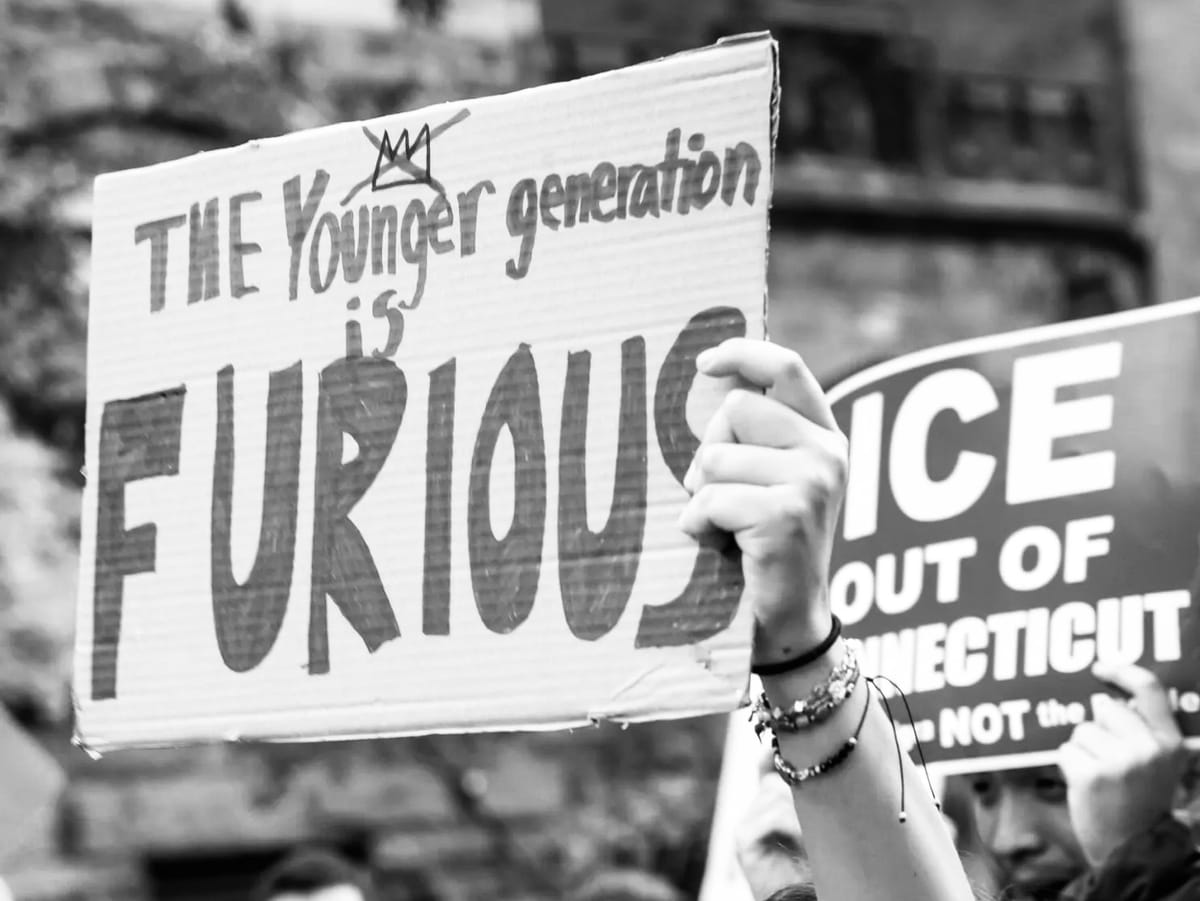
This weekend, between 8 and 9 million people joined protests across the country and the world—the latest iteration of a sequence of mass protests that have steadily grown in scale and reach, while remaining largely peaceful and even jubilant. Despite the fact that protests are typically rebuked if they turn violent in any way, the congenial, intergenerational feel of the No Kings protests has led to some criticism of their seriousness and their impact beyond the day. A common refrain among the media and online has been that protests like this are empty displays, rather than powerful reflections of massive political disapproval. The images that emerge from these marches, as impressive as they are in scale, don’t always sync up with the common mental model of protests that change the course of history. To a cynical observer, the pervasiveness of positivity and whimsy in these crowds can appear insufficiently confrontational—even though more overtly confrontational tactics also rarely go over well in media coverage.
To be clear, higher-risk protests are happening as well, such as the confrontations that have taken place at immigration detention facilities. These events are also sometimes necessary and robust research shows that, more often than not, the escalation is prompted by law enforcement not protesters. These riskier actions are also often more predominantly youth-led.
Any effective movement requires both low-barrier-to-entry opportunities that build involvement and stamina and allow people to exercise the muscles of participation, as well as the courage of people willing to take increasingly significant risks on behalf of others as the stakes escalate. The entire web of engagement is important, and it is all happening.
But, beyond the simple fact of the necessary range inherent in meaningful, effective community and political organizing, I also think we are at a critical juncture in recognizing and repairing the extent to which young voices have often been critiqued and disciplined, and we have an important opportunity to build more intergenerational networks of support, instead. We don't have to continue leaving kids alone to defend their own futures and then diminishing or punishing their attempts to do so. With profound fears, including everything from expulsion to imprisonment and deportation, still hovering over college campuses nationwide, adults have a choice to make about how we will show up for young people and about whether we care to regain their trust. Opportunities for intergenerational protest are one way to begin to do just that.
The massive, multigenerational crowds appearing at these large, national protests—from babies on adult shoulders to teens (yes, they were there, too) to middle-aged parents to grandparents—may make these events seem overtly more like parades than protests, especially when compared to higher-stakes resistance, where pepper balls and teargas have created war-like conditions on the streets of cities like Chicago, LA, and Minneapolis. But, if that very mixed demographic makes these mass protests seem somehow less interesting or impactful, then I think we might miss the critical invitation that they present to expand engagement and to start to show young people that we are willing to stand with them rather than against them.
We aren’t accustomed to these kinds of images of jubilant, mixed-age crowds. We are more used to seeing the serious, cautious adults and the stereotypically rebellious, risk-prone young people as entirely separate, often antagonistic groups, relegated to different spheres of engagement. And our perspective on the validity of these spheres often shifts with time and hindsight.
When the risks young people are sometimes more willing to take lead to changes that adults, and society more broadly, approve of, we lionize them—though usually only in the rear view mirror. In real time, it is more common for adults to see the risks and moral clarity of young people as simplistic and as counter to serious grown-up aims, as well as a threat to the lines of generational authority we are comfortable holding. And so, in the moment, we tend to punish young people for the very acts we later lift up as brave and pivotal.
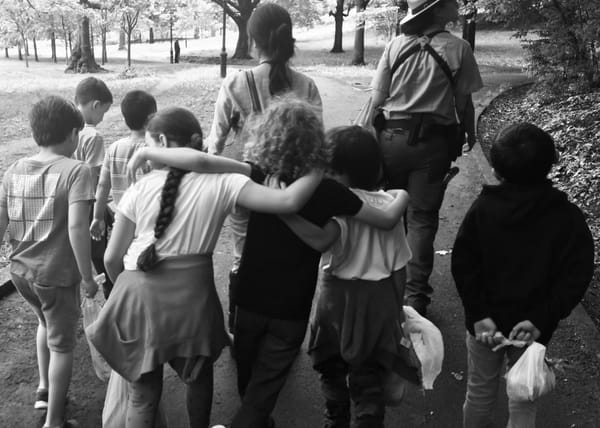
We have a chance to do something different this time. We could recognize, in the many adults who flooded the streets this weekend, an opportunity to show kids that we are actually willing to join them in fighting for their future—that we will neither silence their voices nor expect them to do all the work of effecting change themselves. Instead of framing the wide age range intermingling peacefully in these large crowds as lacking in either the seriousness of adult-only spaces or the teeth of more youth-focused actions, we could see this range as a potential entry point for adults to begin to demonstrate a willingness to support and engage alongside kids.
These marches are only a start. Adults in positions of power have done too much to try to suppress and discipline young voices to expect that young people will accept efforts to repair trust quickly. Adults will have to show that they will also stand by children when the risks are higher and the cost of time and personal sacrifice is greater. This is the long-term work of repair, which is never accomplished through a single moment of apology, but thorough ongoing effort. But, when kids see us out in the streets in large numbers, we have the potential to send a rare and significant message—that we actually want to be on their side this time. What we do next will determine if we really mean it.
Our relationship to children’s voices and political action isn’t the only issue at play in minimizing the significance of this weekend’s protests. In addition to relegating children to the sidelines, we also have a long history of viewing anything intergenerational as inherently domestic, particularly when women are deeply involved, and this is often another easy way to dismiss action as seemingly politically powerless. I urge us all not to fall for any of these tropes, but rather to seize this opportunity to take young people’s voices and their efforts to build a better world seriously and to continue to prove that we are willing show up at their side.
This isn’t just about modeling courage for our children, but also, and perhaps more importantly, about demonstrating that we see and value their courage and that we are willing to put our own skin in the game. We have a long way to go. Kids are right to be wary—yet another reason we will have to be prepared to take the kinds of real risks that parents and grandparents took in Minnesota streets on behalf of kids, when the stakes were high and the threats imminent. But it can be a start if we continue to walk alongside children and amplify their voices as worthy and important, and if we take steps to dismantle the serious restrictions and punitive deterrents we've placed on their voices and replace them with more opportunities for intergenerational solidarity.
Let’s start showing kids that we’re willing to get to the future together.
"No one is getting left behind this time. / No one is getting left behind. / No one is getting left behind this time. / We get there together / or never get there at all. / We get there together / or never get there at all."
Wishing you the courage to stand with children proudly and publicly,
Alicia
A few things I found helpful and hopeful this week…
- The Resistance Will Be Harmonized - I joined multiple Singing Resistance groups at Times Square on Saturday. It was incredibly uplifting to experience the power of music to energize and mobilize the crowd.
- Why Was Minnesota’s Resistance to ICE the Strongest Yet?
- Andrea Pitzer on holding onto our values in oppressive times
- Food aid doesn’t make people loafers – research shows government benefits help low‑income people find jobs
- The Language of Loss - This is just incredibly beautiful and honest.