Take a Moment to Breathe In
And then make sure your breath fuels your next steps


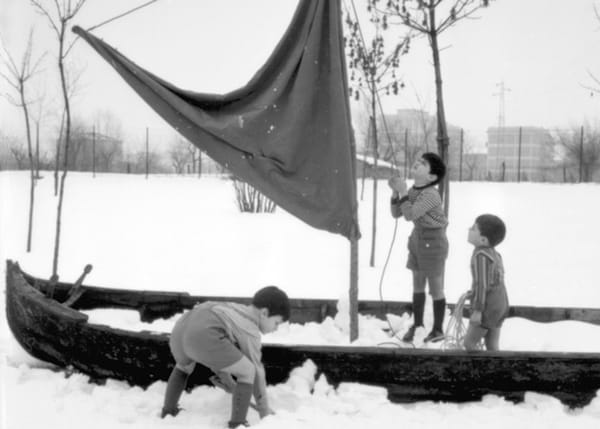
“Thaw
Over the land freckled with snow half-thawed
The speculating rooks in their nests cawed
And saw from the elm-tops, delicate as flowers of grass,
What we below could not see, Winter pass.”
~Edward Thomas
I saw a map recently that illustrated the record temperatures we've had along the coasts this winter. In many parts of the northeast, we’ve apparently had the coldest winter in more than twenty years. It has certainly been a season that has tested our wherewithal and our endurance in many ways, both practically and spiritually. I usually consider myself a winter person, but, as March creeps in on icy gusts and begins to whisper of longer sunlit hours and more color to come, I’ve rarely felt so ready for the tangible signs of spring to emerge. It isn’t really the cold itself that has left me eager for the first buds and traces of green, but the layering of so much heartbreak and fear in every headline and in the eyes of our most vulnerable neighbors.
The world has often felt especially cold and bleak this winter, as so much in the news has been wrenching and has come at us fast and on many fronts. Concrete symbols of hope and renewal feel deeply necessary. In dark times we become more thirsty for any glimmer of possibility. Metaphors orient our perspective and anchor us in disorienting times. I’m eager for the crocuses to show themselves.
There are so many things happening that need our attention and our compassion. Too many children are still languishing in detention in Texas, despite symbolic shifts in power, while an ocean away other children’s backpacks are being pulled bloody from beneath the rubble of our own bombs. Families in Minnesota are struggling to pay rent, as dangers still lurk around many corners, and the media moves on from their quiet heroism. All the while, missiles are launched over homes on another continent, as rivers of fire fill the streets and black smoke turns day to night for children in Tehran. It can feel impossible to determine how to prioritize our attention and resources most effectively, even as it is profoundly heartening to see so many ordinary people stretch themselves far beyond what may have ever seemed possible before this long winter—meeting a sea of need with unwavering devotion, sometimes within and sometimes far beyond their own communities.
I’m often reminded, as crises and heartbreak wait in each vibration of the many devices we hold against our skin, of a lesson I learned while training to manage school emergencies. As I’ve written before, a grim feature of school life today is extensive security training. Teachers and children live in a reality defined, not only by learning, but also by constant preparation for the most terrifying events. I wish this were not necessary. But, within these lessons, an enduring idea I’ve held close from all those surreal drills has been the importance of taking a moment to breathe in, especially when our circumstances easily make it seem impossible to do. The most important moment to breathe in is often the one in which our deepest instincts push us toward breathless impulse.
It’s counterintuitive to think that the most essential time to pause is when the urgency of the moment demands quick action. But, in fact, it is in urgency, when our adrenaline surges and our blood pressure makes our hearts race, that taking a moment to orient ourselves and to refocus our blurry, panic-induced gaze is most necessary. “You always have a moment to breathe in,” they would tell us again and again, as we rehearsed for the unthinkable. I’ve carried this lesson with me because, if it is true that this moment to pause exists even in the most dire circumstances—in truly life or death emergencies—then there is no circumstance when we do not have at least a brief moment to take a breath, regain our footing, and choose the direction of our next step with intention. As news cycle after news cycle threatens to overwhelm our nervous systems, either pushing us into panicked impulsivity, paralyzing us in fear and despair, or tempting us to turn away and ignore the painful realities around us, I remind myself of these two intertwined truths: there is always a moment to breathe in, and that breath can’t become an invitation to desist from action and from finding ways to be of use.
The purpose of taking a moment to pause and breathe isn’t to disengage, but rather to engage with greater capacity for care and for meaningful, useful action. In an emergency, the next step after that crucial breath is always action. But it is more intentional action than we might otherwise have taken. This is the critical difference between the original conception of self-care as it was framed by people like Audre Lorde—a radical, political act—and the commercialized, individualistic version of self-care that risks morphing into just another way for us to purchase numbness or indifference. We can’t take these breaths as a means of tuning out but instead as a way to reorient and tune in more effectively.

In the classroom and as a parent this is also one of the most frequent exercises I’ve walked young children through, as they learn to make their biggest, most unwieldy feelings more manageable, so they can return to problems with renewed purpose rather than be unraveled by them. When I’ve kneeled, eye-to-eye with a young child and practiced blowing imaginary flower petals off their stems or extinguishing birthday candles together one at a time, I would remind them, “As soon as your body is steady, we’ll be able to solve the problem together.” These breaths are only valuable if they carry a promise that we will take our newfound sense of regulation, once we’ve located it, and use it to repair and restore what’s been broken. And, on an even more basic level, there is a promise, when we breathe together, that a calmer, less overwhelming feeling is possible—that this sensation still exists and is reachable—and that we are not alone.
Children need help learning to find their breath when the present feels too big to contain. But the truth is that we adults often need reminders of this as well. And children need us to practice the same habits of regulating our own frenzied minds that we try to instill in them.
In my work with parents, I often remind them that it’s okay for children to see our emotions; hiding all our reactions from our children only teaches them that they are alone in their own feelings. But, as adults who inevitably hold a lot of power in children's lives, it is when we are not able to locate our own breath that we do risk scaring children—when our emotions threaten to spill into volatile or unpredictable actions, or are misdirected at those in proximity, who are often smaller and more vulnerable. As Mr. Rogers famously said, “Anything that’s human is mentionable, and anything that’s mentionable can be more manageable.” The point in this reminder, for both adults and children, is not only about the importance of sharing our inner worlds, but also about recognizing that it is possible to make those worlds more navigable—that in pausing to examine and reflect on our responses, we can slow our racing hearts and move forward with greater intention and care instead of with impulsivity, even when all the alarms of the world are ringing loudly in our ears.
Children need our help and our modeling to learn how to do this and to feel safe in our grown-up capacity to do so for ourselves. And, in a sea of overwhelming news, I think we all need periodic reminders that it is both possible and necessary to breathe in—that there is always a moment to do this, even amidst a cacophony of emergencies—and that the purpose is to be of more use to our broken world, not less.
The second implication of this reminder is at least as important as the first; after we breathe, we must then step back into the fray. If it’s true that we do always have a moment, then it is surely also true that sometimes we only have a moment. Both sides of this reminder are critical. We are more equipped to help make a difference for others if we first take the time to regulate ourselves, and we can only help if we then make sure to put our more focused, centered attention to good use.
We can’t take these breaths as a means of tuning out but instead as a way to reorient and tune in more effectively.
There are lots of ways to calm our electrified hearts and minds. “Breathe in” is a mental mnemonic, not a prescription. Noting that we always have a moment to breathe in is a reminder that there is always a small window to steady ourselves, even when it might seem like there isn’t, and that it is our responsibility to ourselves and to others to do so. It is a reminder that we are, in fact, more capable of being useful, more capable of making a difference for others, and more capable of modeling active, productive engagement for our children when we can turn the volume down on the adrenaline pounding in our ears, so that we might hear our own voice again and choose a vector to act upon, rather than spinning from crisis headline to crisis headline, too overwrought to actually make an impact anywhere.
So, I hope that you will find space to breathe, whatever that may mean for you. And I also hope that, in doing so, you will resist the temptation to separate yourself from the heaviness and heartbreak of the world. Children from Minneapolis to Minab deserve our close attention to the terrors they are facing. They deserve our rage and our tears. And they also deserve every effort we can make, individually and collectively, that takes them closer to a safe world, where there is more room for curiosity and less cause for fear.
Let’s hold onto the promise we offer children when we help them calm their most overwhelming feelings—that there is greater steadiness on the other side of our shared breaths and that, once we locate this steadiness, we have a responsibility to return to the problems we stepped away from and to keep working toward solutions with renewed spirit. Because, while spring will come with its blossoms and its warmer days, whether we bid it or not, there will only be less fear and heartbreak if we continue to pay attention to reality, even when it’s hard, and if we take steps toward creating something better.
Remember and do your best to live out this promise from poet, Nikita Gill,
“If you name it hope instead of impossible.
If you hold it with tenderness.
If you call it the blessing of your ancestors.
If you look around and see the faces
of everyone you love
trying to save the world with you.
Then this work becomes love.
And even mountains will move.”
Wishing you the wisdom to recognize when you need a breath and the compassion and courage to keep stepping back into care and action,
Alicia
A few things I found helpful and hopeful this week…
- Raising daughters in the age of ICE by Meg Conley
- Trans Girl Scouts Sell 330,000 Boxes Of Cookies In Public Outpouring Of Support by Erin Reed
- When ICE came, Minneapolis created underground health networks. Should other cities?
- Whooping Cranes Came Back From the Brink of Extinction. Now, New Threats Are Converging on Their Texas Wintering Grounds
- Minnesota still needs your help to recover