Teaching Kids to Look for Quiet Ordinary Helpers
And to find comfort in the many who are working close at hand instead of in the anointed unreachable few

“the current is there, hidden; and there
are comings and goings from miles away
that hold the stillness exactly before us.
What the river says, that is what I say.”
~William Stafford
I went to a gathering of New Yorkers last week aimed at spreading the work of Singing Resistance from Minnesota across the country. You’ve probably seen videos of Singing Resistance. They began as a small group of community members, right after the killing of Renne Good, seeking to bring comfort to those who were grieving and hope to those locked inside their homes. Within a week, the small group had expanded into the hundreds, and they have since inspired similar groups and trainings far beyond Minnesota. While music as a form of protest has a long history, there has been something particularly powerful about the swelling of this iteration, both in its stark contrast to the extreme violence and fear of the moment, and in the speed and momentum with which their efforts have swelled from a few local voices to a sort of dispersed, national chorus.
One of the things that stood out to me during the evening I spent with Singing Resistance—because I am always looking for the ways children are metabolizing the world around them, especially in difficult and frightening times—was the fact that there were quite a few children sprinkled throughout the hundreds of adults in the room, sometimes singling along, sometimes finding each other, sometimes curled under the arm of a parent, and sometimes twirling in the aisles.
As I’ve written throughout these notes, I believe it’s important to be honest with children about the world, even when it’s hard. I think this is the only way to ensure we are raising children who are motivated and equipped to try to make the world better, and it’s also the only way to ensure they don’t feel alone in their questions or their fears. But navigating how to tell children the truth in ways that don’t further threaten their sense of safety, or sew seeds of cynicism, is never easy. And it is particularly challenging when the reasons for fear and anger seem to multiply and extend their reach every day.
It should be possible to teach children about brokenness more gently—to dose it out one small, manageable lesson at a time like vegetables or skinned knees. I think this is how most of us aim to parent, filling our children’s days with as much opportunity as possible to be immersed in what we consider the normal stuff of childhood, and approaching the more difficult conversations in limited moments like small pockets of harder truth wrapped in the cushion of as much ordinariness as we can cultivate. The particulars of what we imagine the normalcy of childhood to look like vary significantly depending on the texture of our own unique cultural and community contexts. But, whatever that vision of a normal childhood may look like to each individual family, I think we all strive for it; we don’t seek to raise our children in a soup of constant threats and anxiety.
None of us should have to feel we are confronting never-ending dangers and fears, and certainly children shouldn’t have to feel this way. But there are times when the dangers and injuries of the world our children are immersed in grow so loud and ubiquitous that it becomes nearly impossible to titrate them as we might wish we could. We’re living through one of these periods now. The news often feels like too much for adults to keep up with and make sense of, and it is increasingly difficult to mitigate the extent to which our children feel they are also swimming in a sea of troubles.
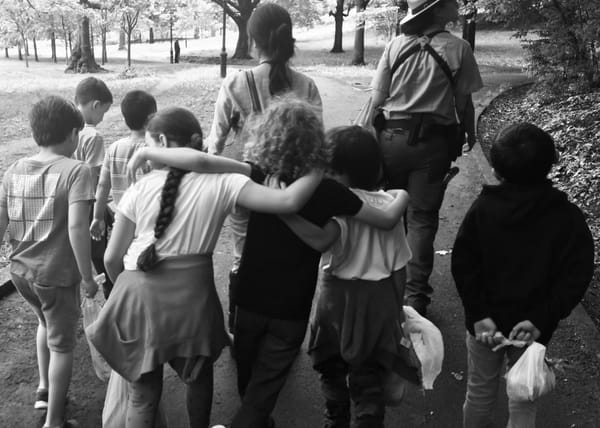
So, as I watched children wave to each other and twirl and climb across pews, amidst so many adult voices, learning songs meant to provide comfort and grounding but also inspiration and provocation, I thought about how many different ways there are for us to counter fear with models of everyday courage and care—and how different this is from the points of inspiration we are often encouraged look to and present to our children as role models.
Most of the education we offer children about how the world has changed in the past is tied to the stories and images of iconic heroes on pedestals, the recognizable faces of history. Even in day-to-day life, we tend to provide children with examples of uncommon or even fictional bravery. From firefighters to cartoon superheroes to historical figures, we offer children models of leadership and courage that may be inspiring and worthy but that can also feel both unattainable and hard to locate in real time. How comforting is it, really, to look to a select group of icons whom most of us feel unequipped to match and who also seem few and far between, peering from the pages of history books as once-in-a-generation figures or charging into danger with unparalleled bravery?
Even as parents lean on the famous advice of Mr. Rogers, encouraging children to “look for the helpers” in times of fear and uncertainty, I think we often go astray in trying to actually identify these helpers. If we believe we have to point to examples who are uniquely emblematic of courage, leadership, or power, or even those who simply have unusually specialized training, we both narrow the scope of helpers significantly, and we make it extremely challenging for children to see themselves reflected in these figures and to find their own agency in their images.
What if, instead, when reminding our children to look for the helpers, we simply reminded them to look around at all the people in their immediate lives and communities showing up in a million quiet, unsung ways? I think this is closer to what Mr. Rogers intended, given that his message to children was always, fundamentally, rooted in the idea of neighborhood and in the significance of our smallest, most intimate gestures of care and listening. This is so easy to forget when we are confronted with our children’s fears and with their awareness of issues that feel overwhelming, even to us as adults. We naturally grasp for the images and the words of the heroes we’ve been taught to name, and in doing so we pass on to our children the unnerving sense that leadership is scarce and that the number of people who can truly make a difference is finite—likely the same notions of courage and power that make us feel unsteady in our adult understanding of the news.
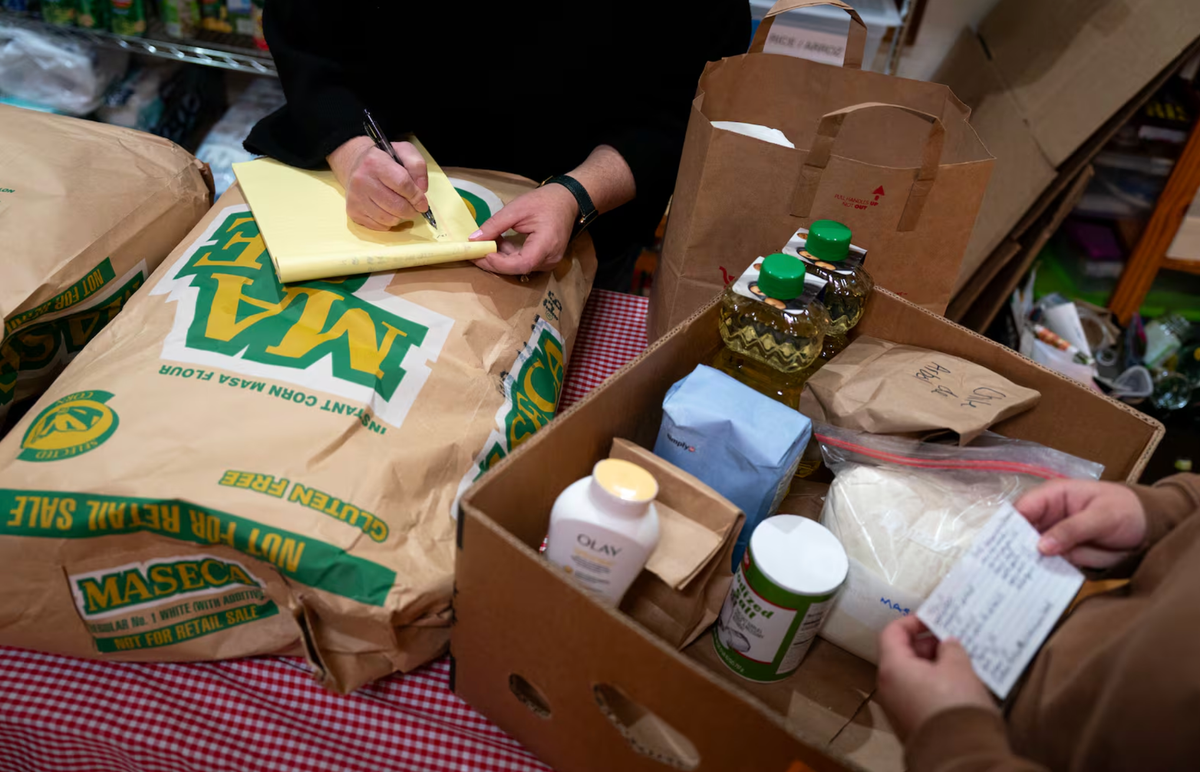
By contrast, what struck me in a room full of very ordinary, local people who showed up, not only for an evening of music, but to learn how to deploy that music toward community care and change, was that the children who were present that night were surrounded by clear evidence that helpers are everywhere—that they are not, in fact, uncommon or hard to find or difficult to emulate. Isn’t it more comforting to think that helpers surround us all the time than that they are rare and special, difficult to locate and even harder to become? This is the most fundamental lesson Minnesota has offered us, and one we shouldn’t let fade into the shadows of past news cycles, as new fears emerge and loom at the forefront of the headlines and of our consciousness. The helpers aren’t only those who run into burning buildings or inspire huge crowds from spotlit podiums. The helpers might be doing laundry or driving your teacher to school or keeping watch at a bus stop or delivering groceries or organizing to pay someone’s rent or singing to your neighbors from the street.
And these lessons don’t just apply to any one specific issue or situation. Everywhere, everyday people are doing quiet, ordinary things to help each other and to address the problems at the heart of even the most frightening stories in the news. It can feel like this isn’t true because, outside of extraordinary circumstances, none of this care makes headlines or goes viral. Heroes can feel hard to come by and those we expect to be leaders can be startlingly absent or timid. Trying to become a hero in the shape of the paradigms we are taught to hold up can keep us suspended in the uncertainty of not knowing where to begin. Or it can lead us to self-aggrandizing gestures that often do more harm than good. But helpers? They are everywhere if we refine our definition and refocus our gaze in search of quiet, ordinary people showing up in small but meaningful ways, instead of singular flashes of brilliance and big acts of bravery.
Whatever issue or news story or overheard conversation might have your child (or you) feeling anxious and afraid, there are surely people doing concrete, helpful things to address that very issue. And you don’t even have to know who those people are the moment a scary event happens or a child asks a question that stops you in your tracks. The rush of adrenaline that we feel in these moments, when children ask us to assure them of their stability in the midst of a profoundly unstable world, is perhaps what makes us most likely to reach for the obvious touchpoints. When we are, understandably, at a loss for words in response to our children’s fears, it is tempting to want to supply clear-cut reassurance. In our urgency for the right words, it makes sense that we would most easily come up with the examples that we are primed to carry on the tip of our tongue.
But what if, instead of offering the established images of unreachable icons or the names of leaders who might be floundering themselves—or worse, contributing to the problems and the pain—we practiced saying, “let’s find out together who’s helping with that.” This response might feel inadequate, because it isn’t definitive and it does not offer an external picture of strength to pour our fears and our children’s fears into. But I think this response has the potential to operate on several levels, for children and for us, that are more powerful, both in the moment and over time.
First, promising to search together for the very specific helpers who are trying to make a difference on a very specific issue, signals to children that it’s okay not to have immediate answers, while also extending the assurance that answers can be found and that they don’t have to look for them alone. Second, looking for the people doing practical work close at hand also encourages children to rescale big, overwhelming issues into more manageable, actionable problems that actually can be addressed, or at least chipped away at. And third, reminding children that they rarely have to look far to find helpers when they are afraid, and that the work of helping can actually be done by ordinary, recognizable people, creates a much more full embrace than reaching for an abstract, far-off stranger. The proximity and familiarity of these helpers also acts as an invitation to our own agency and theirs in a way that isolated figures rarely do.
We don’t have to have all the answers for our children, nor do we need to make assurances that we know will ring hollow in the face of their fears. But we can always offer them examples of care that are within reach. Even if it seems that these quiet, ordinary people have far less power than those who may be the source of a child’s fears, or who we believe ought to rescue us, there is a different kind of comfort in the sheer number of regular people working steadily toward change, and in the immediacy of their efforts.
“When it is all too much; when the news is so bad, meditation itself feels useless, and a single life feels too small a stone to offer on the altar of peace, find a human sunrise. Find those people who are committed to changing our scary reality. Human sunrises are happening all over the earth, at every moment.
People gathering, people working to change the intolerable, people coming in their robes and sandals or in their rags and bare feet, and they are singing, or not, and they are chanting, or not. But they are working to bring peace, light, compassion, to the infinitely frightening downhill slide of human life…
Always remembering that there is nothing too small any of us can learn to do to help us out of our predicament, and that learning to extend the range of our compassion is activity and work available to all.”

Singing Resistance NYC, March 2026
Wishing you the care and community of ordinary people showing up beside you,
Alicia
P.S. The song above was led by a member of Singing Resistance: Minneapolis, who shared that when they sang this to families locked in their homes from the street, they could often see children watching and listening at their windows. Some would blow kisses to the singers. The lyrics, by Heidi Wilson, are: "Hold on, hold on. My dear ones, here comes the dawn."
A few things I found helpful and hopeful this week…
- This group of therapists is so close to raising enough to provide care to children in Gaza. Help them get across the finish line in their final week of fundraising!
- Twin Cities residents to receive Profile in Courage Award
- How a Minneapolis childcare center survived the ICE surge – and is moving forward
- Tennessee librarian refuses to move LGBTQ+ books