The Map of Other People’s Hearts
And the bonds school offers that no curriculum or technology can capture

“The number
of hours
we have
together is
actually not
so large.
Please linger
near the
door uncomfortably
instead of
just leaving…”
~Mikko Harvey
The New York City Department of Education ran an ad campaign in the subway system in the early 2000s that featured the line, “You remember your first grade teacher’s name. Who will remember yours?” It was written in white lettering against a black background, evoking chalk on a chalkboard (remember chalkboards!). I pictured my first grade teacher whenever I saw these signs. The city’s new schools chancellor has credited the campaign with inspiring him to become a teacher and I’m sure he’s not the only one. The ad tapped into a common well of recollection that most of us can readily access. It did not conjure a particular lesson, skill, or academic achievement. Instead, the signs momentarily re-illuminated a formative relationship, tucked deep within our individual memories.

Beyond sentimentality, we rarely talk about education in such specifically relational terms. We talk about curriculum and test scores and standards and college readiness and the jobs of the future and a million other things that can easily become cold and analytic—almost as if they could be poured into a child without any human interaction at all. Of course, this is not how human learning works, and we have a host of research to prove this. The human mind learns through connecting with others. We know this scientifically and we know it intuitively, or the message of that subway ad would not have been effective.
As educator and author, Benjamin Riley, said recently in an article on the role of AI in education,
“Human beings have evolved to learn from each other in the context of our relationships. This is the superpower of our species...”
The human brain is wondrously connected to other human brains—a super power that gives us extraordinary collective capacity, but one we often take for granted. Children's learning is not, in fact, equivalent to training a digital tool. It's common for the social nature of development to be relegated to the sidelines of educational discourse under the umbrella of “social emotional learning,” a phrase that’s always made me bristle a little, because it gives the impression that our relational experience can be reduced to discrete skills. Our social development can't be checked off and mastered for a quiz, separate from our other experiences; relationships form the context within which all other learning occurs. And, as importantly, our relationships are valuable and formative, not only because of the learning they facilitate or the skills they foster, but also for the very simple reason that our relationships matter for their own sake.
Even with no correlated learning outcomes or concrete skill benefits to justify their significance, our relationships are always important. This is true for children and it is true for adults. For children, though, school is the primary place they form relationships. Some of these relationships will hopefully be nourishing and lasting. Some will surely come and go with little fanfare. Some relationships will be fraught and leave scars. Some will shift the trajectory of a child’s life in powerful ways and others will leave only faint recollections. But all of these relationships matter, regardless of whether they facilitate learning or foster new skills, because the relationships themselves are significant.
Of course, the core function of school is learning. I’m a teacher. It would be silly to dispute this. And there is always worthy discussion to be had about the defining purpose animating this central goal—whether the aim of formal learning is primarily the development of participatory citizenship, the deepening of the individual soul, or preparation for future employment.
But, in addition to all these aims, school is also the place where we spend the majority of our time for anywhere from thirteen years to over two decades. The relationships with both peers and teachers that we form across all those years are meaningful and valuable all on their own. Many of these connections surely spark learning and drive intellectual curiosity. Lots of research tells us that this relational magic is at the heart of good teaching and deep learning. But our connections to others are never only important for quantifiable reasons or because they lead to some data-driven achievement payoff. Our relationships are important because they weave the fabric of our lives, shaping us in ways that can’t be measured, filling our days with meaning, and keeping us connected to life itself.
Questions about what particular form of interaction between teachers and students produces the most learning, as well as what form of peer experience is most beneficial, have been pedagogical hot topics since the days of Socrates. But, as we increasingly grapple with the degree to which technology should or should not be a filter through which learning is sifted, it is more necessary than ever to understand and make explicit the value of human relationships in educational contexts.
For the record, I do believe that technology has utility in education and can play a powerful, positive role in learning and even in relationship building. Perhaps most importantly, some technology can facilitate access to education for students who might otherwise struggle to find their place in the classroom or who might be left out of formal schooling entirely for a host of reasons. I worked for a fully online school for several years and, among other things, we established a safe learning community for children living in literal war zones, as well as children managing significant medical conditions and other life circumstances that made traditional classroom life difficult or impossible. I’ve seen the force for good that technology can be in education first hand. And conscious, intentional relationship building, especially in an online community, was at the heart of what made that school, without walls or borders, a safe and nourishing learning environment. The value of the technology in this context was that it connected people to each other.
Much of the ed-tech discourse misses this critical aspect of learning and of all we gain from the relationships we form at school. While it is always the primary job of teachers to consider the best route to learning and knowledge, many other important things also happen in the course of a school day, not all of which are explicitly related to the curriculum. The value of the relationships school brings into our lives is bigger and richer than any measure of content knowledge or skill acquisition alone can encapsulate.

For decades, early childhood educators and pediatricians have tried to make this point with regard to screens by explaining that, in addition to the specific content children may see, the amount of time they spend gazing at a screen also matters in and of itself, if it reduces the amount of time they spend gazing eye-to-eye at another human. It's not about the screen time; it's about the loss of human contact. This is related to learning on one level, because children do acquire critical language and communication skills through these early, intimate interactions. But it also points to the importance of the relationships themselves and to something ineffable that no approximation or imitation of human interaction fully captures. Through their interpersonal bonds, children learn to trust, to feel connected and valued, and to read feelings with growing empathy. It is in the exchanges of smiles and tears and the first babbling attempts at conversation that young children are invited into the world of human connection. This time is so essential that missing out on it can have a profound developmental impact, not only on learning and attaining milestones, but also on lifelong wellbeing. Human relationships foster learning. But they do not only serve learning. They shape our developing humanity. Anything that takes us, and especially children, away from these connections has a ripple effect.
The significance of these interpersonal bonds is especially notable for the very young, but our relationships continue to be a critical vein in our growth and wellbeing throughout life. Relationships matter at every stage, not only because of what we learn from them or because of how they advance us through achievement markers, but also—and perhaps most necessarily—because they are so central to the sense that our lives have meaning and purpose. There is no replacement for this, precisely because humans and human relationships are so messy and imperfect.
Sometimes the people in our lives rise to levels of care we never anticipated. Sometimes they fall short and fumble in awkward, exasperating, or even heartbreaking ways. Sometimes they validate our deepest feelings and sometimes they tell us unexpected but necessary hard truths. Sometimes they make us laugh when we don't know we need to. Sometimes they fail to pick up the phone when we most want to hear a familiar voice. But sometimes they answer on the first ring and bring us to grateful tears. None of this is ever algorithmic. Our relationships at every stage of life can be both reassuringly predictable and surprisingly unexpected. And it is in all this human texture and love and fallibility that the meaning of our lives takes root and grows.
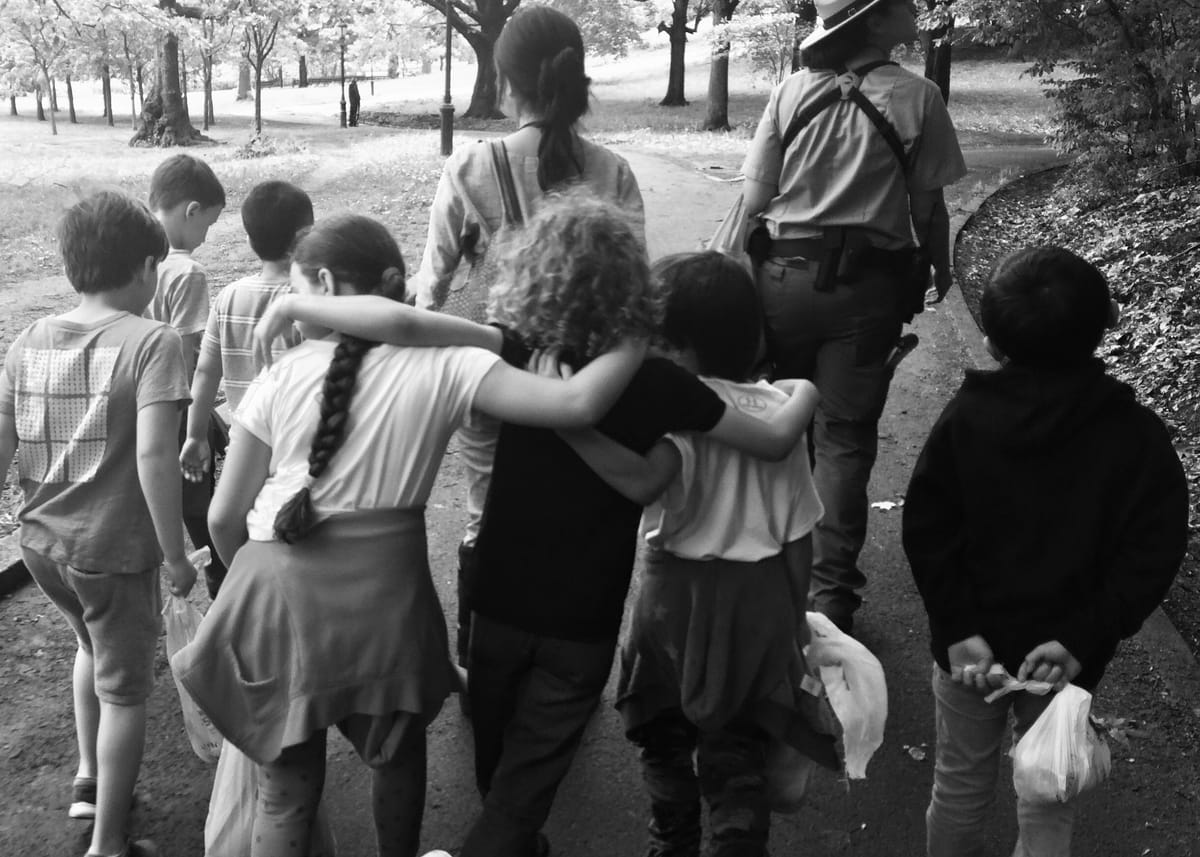
For children, the majority of these vital connections originate and take shape in school, simply because that is where so many hours of a child’s day are spent. The relationships we navigate over the course of our long educational lives are profoundly important for many reasons, some of which have to do with the explicit goals of school, and some of which have very little to do with these goals.
Reflecting on my own education, there is the friend I met in first grade, whom I spent the afternoon with this weekend—a lifelong friend whose value in my life has very little to do with anything either of us learned in school. But, we only know each other because we shared a classroom where we also happened to read Frog & Toad, stack unifix cubes, and feed the class turtle and the tadpoles. There was the teacher who became a surrogate aunt in seventh grade, when my mom was dying of cancer, taking me for tea and pastries every Friday, because I needed someone to do that but didn’t know I needed it. There was the college friend who somehow called at the exact right moment during a difficult stretch and then flew from Seattle to New York and showed up at my door. Our paths would never have crossed without school. There are the graduate school professors who I now count as colleagues and friends. Many of these are people, friends and teachers, I learned important things from or alongside—people who held a significant role at various points in my educational arc. But they are also all people I value for reasons that have little to do with anything that could be mapped in a curriculum or replicated by a computer.
The relationships we form in school, across many years, are at least as important as the academic learning they contribute to. And, yes, I remember my first grade teacher vividly. Who do you remember? What bonds did you form in school that shaped who you are today? Are any of them still in your life?
It's important to have conversations about pedagogy and curriculum and about the role of technology in classrooms—to pay close attention to when technology or any other classroom tool genuinely creates access that might otherwise be lost and when it poses serious risks. It's important to always consider these questions with the best interests of children and students at the center of our focus, not the interests of corporations. And it's important not to lose sight of the fact that learning through relationships is a human super power that should always be protected and prioritized.
But let’s also remember that these bonds are vital all on their own, regardless of what academic accomplishments they may facilitate. And let's fight for every child's right to experience those connections and to live a life full of care in all its human improbability. Because our relationships always matter, even if their worth is evident nowhere but in our own hearts and the hearts of those we care for.
Wishing you connection, care, and the buoy of a loved one’s gaze,
Alicia
P.S. There are some especially good links this week! Be sure to scroll down and click on these helpful & hopeful resources.
A few things I found helpful and hopeful this week…
- This therapeutic initiative to help children in Gaza heal only has two weeks to raise the funds necessary to launch it's first 6-week intensive program. Help them help kids recover from unimaginable trauma.
- Minnesota Organizers Against ICE is a beautiful mini-documentary about how organizers responded in real time to rally an historic defense of their neighbors with courage and care.
- When everything is failing, what makes people show up for each other?
- 50 Ways to Meet Your Neighbor - Simple ways to start building community wherever you are
- What Was Lost: A Queer Accounting of the NY Times Book Review, 2013-2022
- And two articles about parents protecting their trans kids—these moms who risked arrest for their kids' medical care and these parents in the South organizing to create welcoming alternative spaces.