The Muppets & The Poetry of Everyone
The radical act of finding joy in unfettered belonging

“…I laugh through eyes
that have known the buds of tears.
I believe the world is beautiful
and that poetry, like bread, is for everyone."
~Roque Dalton
translated by Jack Hirschman
When my now-teen son was two, he was obsessed with the original Muppet Show. It all started with a clip of "Mahna Mahna," which his grandmother had shown him on her iPad. He would watch the fluorescent trio signing on a loop and dissolve into tears when it was turned off. So, at some point, I let him watch it in context, if only to save us both from the infinite loop, and he never looked back.
The Muppet Show was never really aimed at young children in the way that Sesame Street was. It was a blend of old-school vaudeville and contemporary late-night variety show. It was full of irreverence, off-color humor, absurdity, and a decidedly adult range of celebrity guests. But the zany antics of the motley Muppet crew drew my little toddler fully in, as they tend to do across all ages. I suspect some of what we might presume to be above a young child’s head was also part of the appeal. Lots of jokes certainly flew past him, but the range of emotions and characters didn’t. No one understands big feelings and big personalities quite like a toddler, after all.
It was definitely amusing to hear a two-year-old, oddly versed in the cultural icons of the late 1970s, requesting episodes by identifying the guest stars of another era, from Johnny Cash or Debbie Harry to Jean-Pierre Rampal or Rudolf Nureyev. Though he no longer remembers all of these figures, I’m sure something of this early exposure to such a wide range of talent planted the seeds of a broad pallet of cultural taste, which he maintains today. In addition to the range of performers, I hope that all those hours spent watching The Muppet Show in his earliest years also planted seeds of comfort with individual difference, emotional expression, fallible relationships, and, most importantly, with the idea that even amidst all our differences and the confusion this sometimes creates there can be unshakable belonging, care, and solidarity, too.
These themes are typically explored in much tidier ways in media that is explicitly intended for young children, if at all. But human experience is rarely tidy, and I think the combination of absurdity, full-chested humor, and sincerity on display in The Muppet Show managed to feel, somehow, like both a ridiculous, imaginative escape and an honest reflection of reality to children and adults alike. The Muppets are at once not human and profoundly human, which allows us to approach and recognize our own chaos and our fallibility, as well as our most earnest emotions, with an uncommon degree of openness.
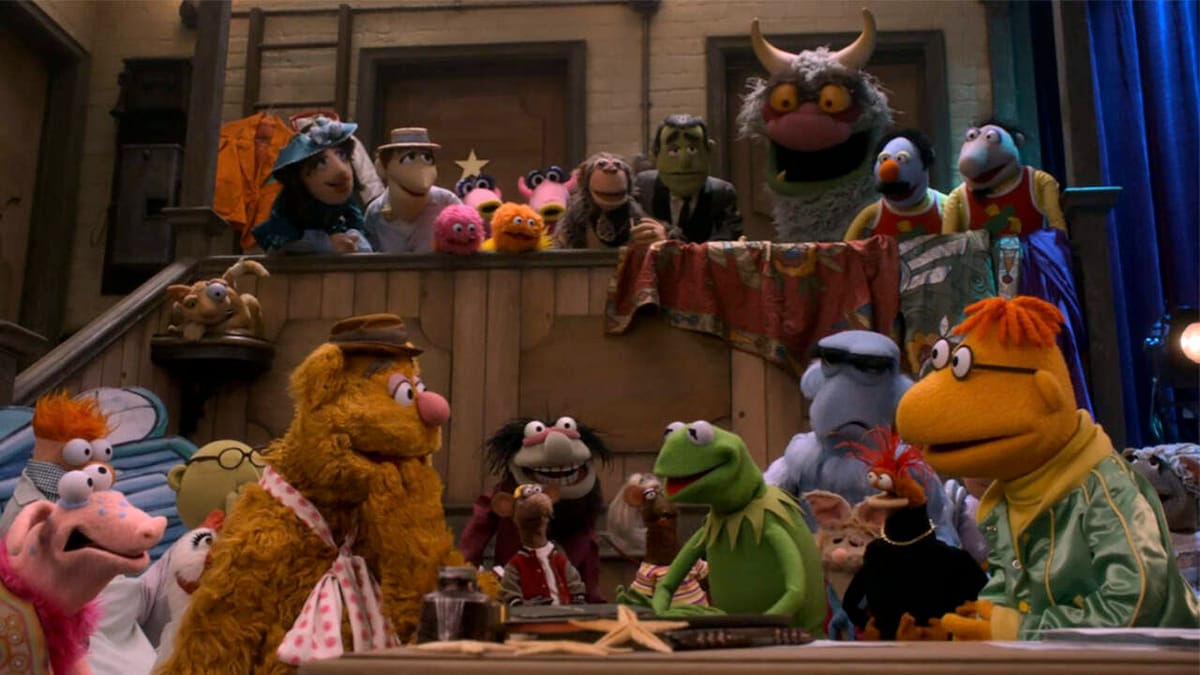
In case you missed last week’s return of The Muppet Show, the gang is back! This latest attempt at a revival has been widely praised for capturing the spirit of the original show—its exuberant silliness, its bawdiness, its mayhem, its earnestness, its unabashed fun, all bound together by a sense of radical belonging. And I think we need all of this right now in a big way.
Often visions of acceptance and belonging, particularly when packaged for children and stamped with age-appropriate mass-market approval, are wrapped in a saccharine simplicity that may be appealing in an easy-to-consume way but that doesn't bear much resemblance to the fraught nature of real relationships in the real world, even for young children. The truth is that those we know well and love drive us crazy sometimes, as do the people we interact with more cursorily in day-to-day life. Both those we care for intimately and those we might just happen to live alongside often strike us as weird, confusing, or exasperating. We humans are a challenging bunch, and we can be a bit of a mess in both our personal and peripheral interactions, as our varied personalities, histories, and preferences collide, and we do our best (or not) to make sense of each other and to find points of connection.
The Muppets embody this in everything from the colorful range of their fur and feathers to their not-so-infrequent misunderstandings, mishaps, and outright brawls. And truthfully, don't we all occasionally feel so frustrated with a coworker, a random neighbor, or even our best friend or spouse to wish for a moment that we could launch them out of a cannon? The technicolor disagreements and disasters that are a constant theme on The Muppet Show are funny, not just because they are bold and ridiculous and full of punch lines, but also because we recognize in them the unavoidable fallibility of being a person just trying to find our way among other people.
And yet, woven into this honest, if extremely silly, representation of how truly difficult it can be to live with each other, another theme arises again and again on The Muppet Show. No matter how badly things go awry or how much we may wear each other thin, ultimately it is always the coming together that matters most.
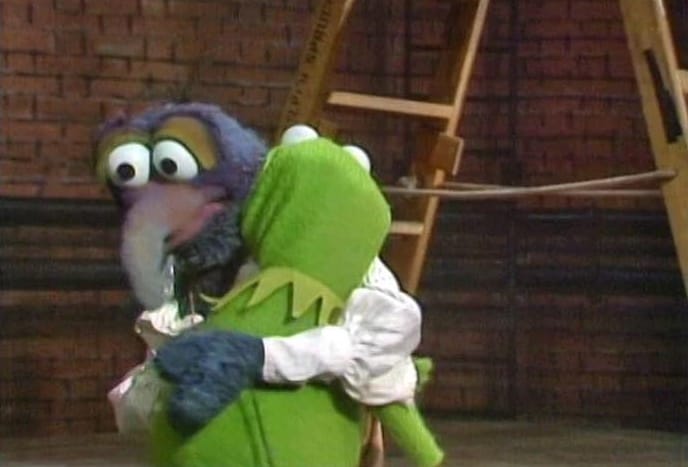
One character, seemingly alone and vulnerable (usually Kermit but not always), often standing amidst a literal wreck of catastrophic failings, from collapsed scenery to random explosions, is a frequent Muppet visual. But that lone character is eventually always surrounded by a group of wildly diverse, often disheveled fellow Muppets rallying collective, if imperfect, support. No matter the difficulty and the mess of living with each other, it is still somehow always possible for us to belong to each other. The ultimate moral of collective care and kinship embedded in that message is perhaps the most significant idea the Muppets offer us. But the fact that this moral is transmitted through a lot of absurdity and chaos and frequent emotional outbursts is also important. Looking after each other isn’t always easy. Sometimes just being in this world together isn’t easy. It certainly isn’t tidy or orderly or saccharine. But it’s possible—if we choose for it to be, again and again, despite all our differences and our failures and our most spectacular fumbles. And it’s worth it.
I think the belief in this possibility is actually exactly what is at stake in the moment of history that we're all living through now. On a very basic level, solidarity and belonging are what’s at stake in the streets of Minneapolis (and LA and DC and Portland and Chicago and an increasing list of other places), as neighbors come together to protect each other in sometimes chaotic, but deeply caring and committed ways—not just in spite of their differences but in defense of them.
We need reminders at every level of cultural expression for all ages, from the Muppets to Bad Bunny, that it is possible to live together and to care for each other, no matter how wildly different we may be and no matter how challenging and chaotic this can feel sometimes. We need reminders that show us how exasperating and full of failures and mishaps this process often is, but also how full of persistence, determination, and love it can be. Because that’s what living together and standing up for each other often feels like. It’s frenzied and difficult at times but it is also possible and profoundly worthwhile.
It would be easy to position the return of The Muppet Show (which will hopefully be more than a one-time event) merely as a fun distraction from all that is so heavy and serious in the world right now. And it is that, too! But, both in spite of and because of its delightfulness and its levity, I think the themes of The Muppet Show are not only an escape. They are also deeply relevant, as we all figure out how to take better care of each other and how to defend our differences in the face of those who insist on stripping difference away.
After all, as children’s book illustrator, Christopher Meyers, writes, “We are most human when we laugh with one another.” And as Ross Gay reminds us, “Joy is an ember for or precursor to wild and unpredictable and transgressive and unboundaried solidarity.” The point of noting the deeper messages in something as seemingly silly and light-hearted as The Muppet Show isn't to strip it of its joy or its humor, but rather to recognize the power that joy and laughter can have.
These are ideas that I think Jim Henson understood and consciously stitched into the Muppets—the belief that difference isn’t always neat or easy, but it’s ultimately only by embracing difference that we can find true belonging, and that laughter and absurdity can be avenues that lead us viscerally toward this understanding. A power of children’s storytellers is often that they know the most important messages can be subversive in their simplicity and their levity, and these messages speak to us across ages and generations.
Adam Serwer wrote recently, of the networks of care and community defense that have emerged in Minnesota and beyond,
“If the Minnesota resistance has an overarching ideology, you could call it ‘neighborism’—a commitment to protecting the people around you, no matter who they are or where they came from...”
At its core, this is the same lesson children, and the adults sitting beside them, can learn from a bunch of wacky, furry, rainbow-colored creatures who routinely flail and flounder, but who, in their array of difference and weird individuality, always create a wide embrace in the end—and who will stand up to any bully who threatens their unexpected kinship.
Off the screen, the stakes of defending difference and standing up for one another are terrifyingly high right now, and the risks are not to be made light of—that’s certainly not my aim here. But I also wonder if the activation of moral clarity on display among neighbors is, at some level, an awakening of the seeds that our earliest storytellers planted in our hearts when we were very young. We’re now being asked to put those values on the line with our bodies in dramatic and frightening ways in real life. But the values that push us to do so remain strikingly simple—as is made clear by the fact that children are articulating and living up to them, even in this scary moment, as well as the adults who care for them and for their friends.
Serwer goes on to say,
“No application of armed violence can make the men with guns as heroic as the people who choose to stand in their path with empty hands in defense of their neighbors.”
I think this is ultimately a lesson we were given by people like Jim Henson when we were young and one that always bears repetition, as we reawaken those lessons and bring them to life when it counts.
So go watch The Muppet Show. Laugh. Let it distract you and lift your spirits from the darkness of the news. That is the job of comedy and of our most nostalgic childhood narratives.
And then let that feeling lighten your step and embolden your heart, as you find ways to stay in touch with its simple wisdom and link arms with the real-life cast of characters in your own communities. Because igniting solidarity through laughter is also the job of comedy. And establishing the roots of courage and care is also the task of the stories we tell our children.
Wishing you old friends you’ve just met and love you can hold like invisible strings,
Alicia
A few things I found helpful and hopeful this week…
- It's happening: A sea change is underway. Take heart, and keep going. by Andrea Pitzer
- Somali Communities Are Building Collective Power by Jamila Osman
- This whistle fights fascists: How thousands of 3D-printed whistles are derailing ICE. by Sean Hollister
- These are the high schoolers taking a stand against ICE: 'You can't let despair take over.' by Lex McMenamin
- This beautiful episode of Vibe Check with Saeed Jones & Zach Stafford about Alex Pretti
- And...How to get along with beavers!