Why Kids (and All of Us) Need Snow Days
The importance of stepping away from apparent purpose

“Before the nightfall, they’d better find where the last sprays of seeds
have fallen,
they’d better find shelter from the wind.
And there they go, tiny rosettes of energy,
as though nothing in this world was frightening—
as though the only thing that mattered was to praise the world
sufficiently—
as though they were only looking, light-heartedly, for the next
tree in which to sing”
~Mary Oliver, "Finches"
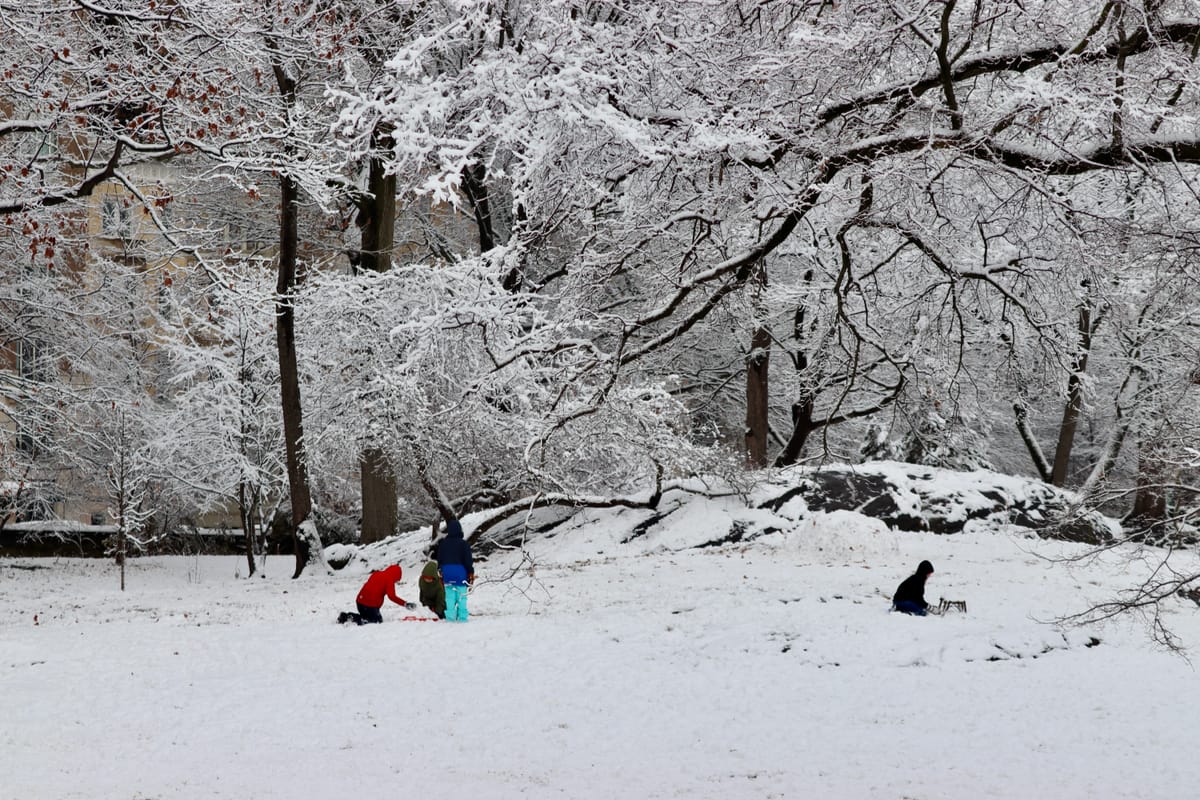
The snow in New York just began sticking to the branches and accumulating on the sidewalks as I’ve been writing. But those who segment the atmosphere and peer into the future with their swirling maps say that a blizzard is working up its gusty strength, and that we will wake up to a blustery, white world, deep in snow. It's already started to pile up with many hours still to go. The city has directed traffic off the roads and announced that schools will be closed. To the certain delight of many children, the mayor also announced that this will be a true snow day, without any remote learning requirements—a departure from the usual policy of recent years made possible, within the web of red tape that defines city regulations, by an exception for emergency declarations. It seems a rare example of a bureaucratic subparagraph that actually works out well for kids.
The giddy excitement that snow days provoke for children isn’t just about a break from school or a day off. There are plenty of other days off from school, which kids may be glad for, but that don’t prompt the same effervescent glee of a snow day. I don’t think it’s entirely a result of the unexpected, unplanned surprise of snow days, though that’s certainly a factor in their delight. I’ve seen schools close in an impromptu way for lots of other reasons—heating malfunctions, for example. These announcements are not met with the same joy, because it isn’t only the unexpected day off that lends snow days their seeming magic. It’s the combination of the unanticipated freedom and the invitation to play that the snow itself provides.
As adults, we often look at snow beginning to accumulate and think of all the tasks it will impede or make more difficult. And rightly so, to some degree. In addition to making the roads treacherous, severe weather can make access to basic necessities like groceries difficult, and it can be downright dangerous for the unhoused. I don’t discount these very real practical and safety considerations. It is always important to take the power of nature seriously.
That said, for most adults, the disruptions we groan about are usually primarily related to the impediments to productivity that snow and a forced pause create. And this, I think, is precisely why children relish snow days so much and why it’s worth considering their real value, as well as the implications this value might have for the rest of our lives, when the weather and local decrees don't force us to engage with the world differently, even for a day.
Snow days don’t only release children from their usual scheduled, rule-bound, adult-directed, daily lives—the snow itself is a provocation for children to activate their most adventurous, jubilant selves; it begs kids (and adults when we give in to its temptations, and to our children’s pleas) to explore, to create, and to test their limits with no particular predetermined goal laid out, other than the activity itself. This is what children’s brains are actually most naturally suited to—traipsing out into the world, knee deep in all it has to offer, to see what they can make of their experiences.
Jill Vialet, founder of the non-profit organization, Playworks, has said,
“Play matters because it gives us a brief respite from the tyranny of apparent purpose.”
I think about this often as a teacher, a parent, and in my own day-to-day life. So much of what we do and what we require children to do is defined by apparent purpose—that is, by tasks for which we presume to know and understand the end goal at the outset. Very often, this kind of purpose is defined by others, particularly when it comes to children, who usually don’t have much say in the organization or activity of their daily lives.
In fact, play often feels deeply purposeful to children, but the purpose is constantly being discovered, reimagined, and redefined, rather than being laid out in advance by a set of outcomes that someone else has identified and mapped for them. And there is both a different kind of pleasure and a different kind of learning that comes from a more fluid, self-determined, playful form of discovery. Children deserve as many opportunities as possible to experience the specific kind of joy and learning that only occurs through embracing the serendipity of play. And, if we are honest, I suspect most adults would also relish more opportunities to discover the purpose of their activities along the way, rather than always binding ourselves so rigidly to the goals and metrics that govern many of our grown-up tasks and projects, before we even begin.
Of course, there are times when it is appropriate to set out with a predetermined aim or when developing a specific skill is necessary. And there are times when it is meaningful for children to engage in learning tasks that may at first feel laborious or elude their sense of “why,” but for which an adult-defined purpose is actually worthy and significant, revealing itself over time. However, I would also encourage our adult reflection—even outside the exceptional framework of a city immobilize by snow—on whether we too often position apparent purpose in unnecessary or unproductive opposition to deeper, more circuitous discovery and the purpose that can emerge while wandering through provocative explorations.
When, for example, might reading an excerpted passage, in order to refine discrete comprehension skills, usurp the more unpredictable but often deeper learning that comes from making one’s way through a rich and complex novel? Or when might following an algorithm, step by memorized step, overtake the opportunity to grapple with actually solving a meaningful problem? When might our pursuit of skills rob children of the pursuit of knowledge and meaning? And when might we do this to ourselves, in our one adult lives, to the detriment of greater depth, inspiration, and fulfillment?
Of course, not every day can be a snow day, and not every learning experience can grow entirely from children’s self direction, particularly as they get older. (I will argue endlessly for as much uninterrupted, self-directed play as possible in children’s earliest years, but that’s a more specific, developmental topic for another day.) But surely children of all ages can also use more of this kind of fluid, unencumbered learning, and of the pleasure it brings, than they typically have access to. Most of us would likely benefit from a little less apparent purpose in our days and a little more freedom to discover purpose through our curiosity.
I think we could all, grown-ups and children, stand to have more opportunities for the unadulterated, gleeful play that snow days provoke in kids. And we could also use more of the unexpected discovery that may require effort and discipline but that only occurs when we release our yardsticks and our preset expectations. We often grow most and come to understand each other and the world we inhabit most deeply when the goal is in the exploration itself, and in the realizations that our explorations lead us to, rather than in the discrete practice of skills or in the replication of products. It’s harder than it ought to be to make space for these kinds of experiences for children or for ourselves, despite the benefits. But it's worth it when we do. We feel the value viscerally when we are transformed by understandings we could not have predicted or determined in advance.
So, if you are in the Northeast and are snowed in, I hope you will be able to carve out some time to play and to embrace the sense of gleeful magic and delight that children experience when they are relieved of apparent purpose and let loose to be the adventurers in the world that they were meant to be. And, if you are not in the Northeast or are in a place that never experiences snow days specifically, I hope there are other opportunities once in a while for you to embrace this same spirit of liberated, playful exploration.
As is often the case, children have worthy lessons to share in the way they engage with the world—curiously, whole-heartedly, and playfully. It is helpful when nature thrusts an invitation to play at our feet, but we would all benefit from cultivating such opportunities, even when they are not so dramatically presented.
Wishing you moments of playful exploration, free from apparent purpose,
Alicia
A few things I found helpful and hopeful this week…
- On Joy and Resistance by Dan Sinker
- The Minneapolis Resistance Will Do Your Laundry by Deborah Copperud
- In the Fight Against ICE, Kids Are on the Frontlines by Madeline Lane-McKinley
And a few Notes on Hope essays from the archives on play, curiosity, and discovery...
- The Magic of Middle School Band
- Following Desire Lines
- On Slowing Down and Looking Closely
- What Medium Would You Wish To Be Drenched In