A Different Kind of Flight
Raising capable, confident kids who aren’t afraid to care or be cared for

“I feel my boots
trying to leave the ground,
I feel my heart
pumping hard. I want
to think again of dangerous and noble things.
I want to be light and frolicsome.
I want to be improbable beautiful and afraid of nothing,
as though I had wings.”
~Mary Oliver
There’s a magnolia tree behind our apartment that becomes a perch for at least one nest every spring. Its sturdy branches and large, dark green leaves do seem like an inviting and sheltering home. If I were a bird, I’d be glad to make a nest there. As summer gets into full swing, this means that a few awkward, curious, clumsy fledglings often start to show up, hopping around inquisitively, without the same sense of apparent purpose the adults show, investigating the world beyond their nest and testing the freedom and coordination of their newly sturdy legs and feathered wings. They are usually nearly indistinguishable from their parents, except for their lack of industriousness and their tendency to be somewhat bumbling and tipsy.
For many doting bird parents, the wobbling independence of these fledgling days marks the end, or the approaching end, of their role as caregivers. Within a year, most parents and their offspring won’t even recognize each other or have an inkling of their former bond. This little trick of evolution likely seems inconceivable to most human parents. And yet we often use the image of young birds leaving the nest as a metaphor for our own role in our human children’s lives. We talk of the need to nudge our children out of the nest and of both the potential freedom and anticipated grief of an empty nest. It’s an odd metaphor for a species that holds onto social and familial memories, not only throughout a lifetime, but across generations.
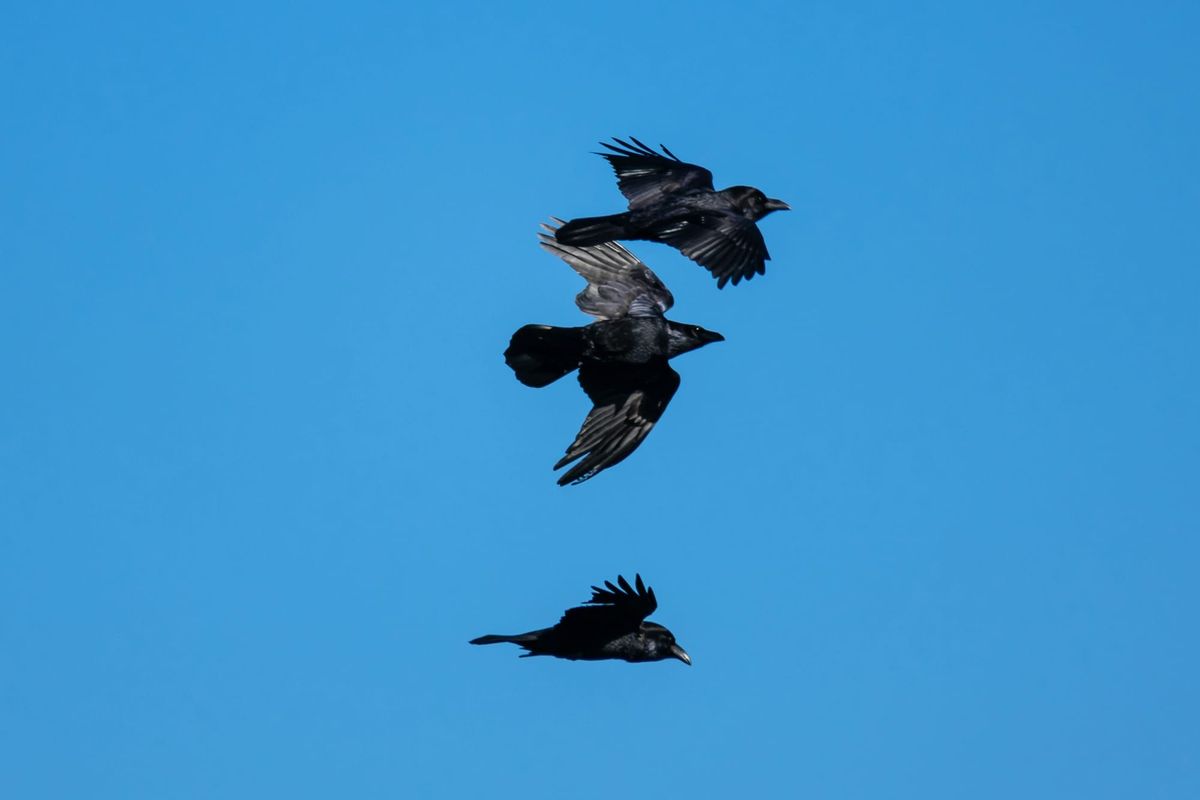
Not all birds, though, cut ties with their feathery offspring the moment they can take flight. Some species have evolved more complex social systems, and for these birds parenting looks quite different. Crows, jays, ravens, and cranes, for example, continue to offer food to their young long after they have fledged. Some species remain together as family units for years, and when new babies hatch, the older siblings become part of their care-giving network, bringing food to the younger ones and “babysitting” when their parents go off to forage. Despite their elongated childhoods, these birds don’t remain wholly dependent. They still develop all the skills necessary to live adult lives, learning to fly, to find food, and to build nests of their own. They just don't do so alone. They don’t forget one another. And, rather than becoming solely responsible for their own survival, they become members of a community of care in which they increasingly occupy the roles of both cared for and caregiver. It is possible, it turns out, to continue to be cared for in community without becoming helpless or failing to develop independent abilities.
As humans, we live through and according to metaphor. We are creatures of story, and we use metaphors to both describe our actions and to guide them. We also rely on metaphors to help us make personal and moral sense of our experiences and our choices. These narrative images matter greatly in shaping and understanding our lives. So, it is sometimes necessary to reconsider the pictures that don’t reflect our lived reality accurately—to find more apt comparisons and to realign the poetry of our meaning making with the truth of our lives and of our values.
One of the mistakes I think we make in many of our metaphors, particularly in those that we rely upon to describe parenting, is that we draw overly sharp lines between independence and interdependence, and we grasp for images that help us solidify these poles. Clarity is comforting, so we erect barriers that hold seeming contradictions at a distance. But, when we look more closely, these distinctions often do not hold; development is more nuanced and requires that we tell more nuanced stories. And the metaphors we rely upon to describe raising children also, ultimately, become the metaphors children use to understand themselves as they become adults.
In fact, among humans, research shows that in communities where a high importance is given to interdependence and mutual care, children often display traits we would consider signs of independence much earlier. It is more common, for example, for children to do things like run errands on their own, or look after younger siblings without an adult present from a young age, when they grow up with an expectation of communal care than when they grow up with an expectation of pure self-sufficiency. At first glance, this may seem like a contradiction, but it isn’t. When communal care is an expectation, children don’t have to be perfectly capable in order to begin trying to do things on their own. When children know there is a web of people who will step in to help them if they falter or fail, they can begin to experiment with independence earlier, because they don’t have to be fully competent to test the boundaries of their capacity and agency.
Ironically, the real-world result of defining independence as a move away from the need for care, rather than as something that can flourish more easily and fully within contexts of mutual support, is that our children remain under our wing for longer. It is harder for parents to trust children to test their newfound agency beyond our watchful eye when we fear no one but us will look out for them. And it is harder for our children to feel at ease taking fledgling risks when the stakes of success are so high. We undermine the very skills we hope to foster when we fixate on the need to go it alone.
This, in turn, creates a shift in our outlook as adults as well. When none of us feels we have to be entirely independent, it is more possible, practically and emotionally, to ask for help, and it is also more likely that we will receive it. For parents, it’s easier to trust that we don’t have to hold our children back until they are fully competent when we know that we aren’t the only adults who will look out for them, and this in turn makes our capacity for care more sustainable.
And beyond the sphere of parenting, this exclusive association of care with the very young—the idea that once we’re out of the proverbial nest, we should be totally competent and self-sufficient—surely also offers permission to withhold care, or fear being in need of care, in other aspects of life. From healthcare, to eldercare, to disability access, to food and housing support, and on and on, we are often reluctant and judgemental of others, and of ourselves when we falter, because we are so shaped by the notion that, once out of childhood, we ought to be fully capable of meeting all our own needs all on our own.

So, back to the birds.
Why don’t they all push their little ones out of the nest as soon as their feathers have come in just enough to catch the wind and be off? What is it about the crows, jays, ravens, and cranes that prompts them to keep offering meals and to recognize one another long past the point when they can flap and forage on their own?
It turns out that, on a number of levels, we have much more in common with these creatures than with the ones who are more quickly and fully independent. Across species, from birds to primates, the length of time that is devoted to childhood is often correlated with the complexity and ingenuity required to be a successful adult. Species that have evolved to do things like solve problems and use tools tend to remain in the care of their families for longer than species who don’t need to do much more than forage for consistent food sources and avoid familiar predators. And it’s not only time that allows for more complex and creative skill development. Access to a wider and more intergenerational social community of care is also significant.
A study of New Caledonian crows, for example, found that adults not only show an unusually high level of tolerance for their own young, but also for unrelated juveniles. The researchers highlight the similarities they observed between these crows and the evolution of humans:
“Corvids have key characteristics that make them a relevant comparison family to understand human evolution. Enlarged brains and reliance on sociocultural learning of skills, enabled by extended development periods in species with prolonged parenting and access to tolerant role models in a safe haven, are likely to result in expanded cognitive skillsets. These conditions were also present in our ancestors, for whom cooperative breeding led to a safe haven where juveniles could learn skills from extended family, including grandparents, and increased group sizes opened more learning opportunities for individuals.”
We don’t have to reach very far for metaphors that are more forgiving of the complex experience of growing up human. Maybe we just need to look to different birds to see that the richness of our human lives and the potential of our human minds might just be better suited to gradual release, to patience, and to participation in a wide and caring social network, than to being nudged out of the nest to take flight quickly and then expected to thrive all on our own.
Perhaps if we modified our metaphors accordingly, we would not only find less anxiety in nurturing our children’s independence, but we would also discover a greater willingness to receive and to extend care beyond the bounds of childhood.
Wishing you gentle breezes to glide on and soft nests to return to,
Alicia
A few things I found helpful and hopeful this week…
- How to help First Nation members who have lost everything in the Canadian wildfires
- The Woman in the Photo Wanted to Be Alone. Instead, She Went Viral. And how you can help her and her family.
- How Philando Castile’s mother helped pioneer Tim Walz’s free school lunch program
- Big gains for little terns: How Lindisfarne reserve is helping a rare bird survive tourism
- Mental health resources for immigrant families in New York
- And if you're confused about lettuce, you're not alone. This is helpful (and infuriating).