Considering Coconuts Together
Meaningful learning is more than inputs and outputs

“and this was happiness
this little ball
of interest beating
inside his chest
beaming out”
~Paul Hostovsky
This week’s poetry excerpt, from Paul Hostovsky’s poem “Coconut,” which is included in full below, is one I’ve long loved, because it encapsulates a deeply recognizable moment between a parent and a child. As an excited child encounters something new, they are initially met with the very relatable rejection of an exhausted parent, numbed by the weight of practical adult tasks. I think most parents can probably see themselves in the overwhelmed adult, and also see their child in the familiarity of curiosity shut down by our fatigue and pragmatism.
Much of parenting is the unglamorous, often draining work of meeting basic needs and keeping day-to-day life in motion, in a social context that offers very little support. We are often running on fumes. It can be hard to join our children in the delight of their discoveries when we are always so tired and worried. The dissonance that occurs between a child’s experience of the world and an adult’s vibrates in the tension between the wonder of their first-time encounters and our depletion at attending to a loop of wonderless obligations.
Yet, when we are able to pause, even briefly, to recognize a child’s fascination and join them in their curiosity, as the author does at the end of the poem, the rewards are deep and palpable. We feel the relief of both the adult and the child, as they finally sit across from each other, mutually engrossed.
It’s a poem about what it feels like to be a child with the capacity to find awe and happiness in the simplest places, because so much is still new and unexplored. It’s about how hard and isolating it can sometimes feel for a child when they can’t pull a trusted adult into that experience. And it’s about the harried, overwhelming feeling of caring for children—but also the occasional miraculous moments when we do manage to look through their eyes.
I’ve always thought of this poem, fundamentally, as being about parenting and about what it feels like to be a child in an adult-dominated world. Lately, though, as I’ve been thinking about what it means to embrace a truly humane approach to education, and about the false binaries of public discourse that often demean and undermine the nuanced work of teachers (squints at a certain viral podcast), I’ve found that the poem also illuminates critical facets of classroom practice and teacher-student relationships.

At the most foundational level, deep learning happens when a spark of curiosity is lit in a context that allows that spark to be fed and tended to so it can grow. Defining the features and parameters of the learning contexts that are most likely to cultivate moments of genuine curiosity, and to extend those moments into deep and durable new understanding, is not simple.
Ask any teacher who has been thrown into a classroom with little preparation or mentorship, as many teachers are, and they will likely tell you that creating this kind of learning environment is not as easy as it looks in the movies, or as cut and dry as those responsible for opining on and setting policy often seem to convey. In fact, they may very well tell you how difficult and complex teaching actually is from the vantage point of some other job, because trying to teach well with little guidance or support leads many teachers to quit.
So much of the public conversation about education, and the decision making that shapes classroom life—which is too often led by people who have never been teachers—does not allow for the nuance and complexity that defines real learning, or the significance of teacher-student relationships that make learning meaningful. Hostovsky’s poem offers a metaphorical alternative; it’s a perfect little case study of the ups and downs of learning relationships.
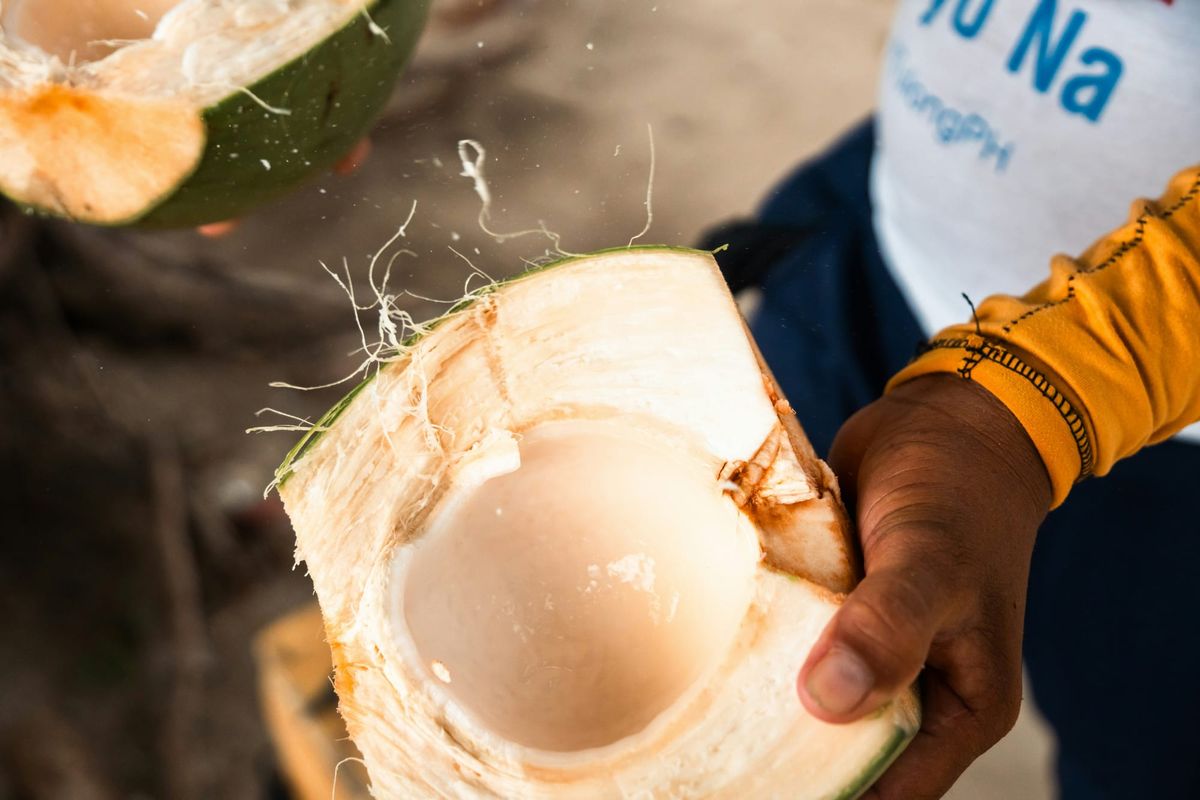
In itself, the coconut is a delightful example of an educational provocation—a spark for inquiry and motivation. It holds enough novelty and mystery in its hard, hairy shell, and in the swish of liquid hiding within, to lead a child to feel compelled “to get inside of it.” It is a perfect learning hook.
In the classroom, such provocations can come from students or from teachers. Sometimes children bring us the most compelling mysteries in the form of a question, object, text, or experience they’ve happened upon outside the school walls. In these moments, it is our job to recognize their beating interest and welcome it.
Like the overwhelmed parent in the grocery store, though, teachers can’t do this if they don’t have the support, resources, and trust to approach classroom life with flexibility and discernment. Sometimes a student’s idea or question makes it worthwhile to put aside the day's plan and take advantage of serendipity. Allowing teachers to do this doesn’t only open new avenues for learning. It also carries the deeper lesson that a child’s ideas and questions matter.
It can also be the teacher who puts the coconut on the table in the first place. A significant amount of the work of good teaching lies in the intentional crafting of such provocations. How a skilled teacher presents a new text, problem, or concept at the outset—and the degree to which the teacher seems curious and interested in their own queries—often determines how motivated children are to stretch themselves to understand something new.
Not everything we do in school is so captivating that it quickens the pulse, of course. But if we lose sight of the importance of sparking curiosity in pursuit of cold outcomes and efficiency in the short term, we will surely also lose wells of knowledge, creativity, and innovation, as the children in our classrooms today grow up.
Regardless of whether that initial spark of interest originates with a child’s question or with a teacher’s offering, what happens next is critical, and this is where the educational binaries that splashy media headlines often stoke really fall apart. No matter how compelling a provocation may be, very little learning is possible without a relationship to nurture that spark and transform it into something more enduring. Children know this intuitively. It is why the child in the poem cries when their fascination is initially rejected. They need the adult to purchase the mystery fruit, sure. But, more than that, they need someone to join them in their delight, to sit across the table, and to wholeheartedly investigate with them.
Don’t we all feel this, even as adults, when we discover something that lights us up—the desire to share our beating interest with someone else?

How we meet children and help them unpack their curiosity, answer their questions, internalize new knowledge, and develop deeper understanding depends on the child and on the nature of the exploration. There is rarely a single path to good teaching, because human minds are complex, as are most things worth learning, and classrooms are dynamic environments. The complexity isn’t a fault to be solved; it’s what education is all about.
At the risk of overdoing the metaphor, a coconut is very difficult to open. It is unlikely that a child would be able to open one on their own. Doing so might involve some research, some direct instruction (the lowercase kind), eliciting the knowledge of a coconut-savvy peer, and ultimately hands-on adult intervention.
But before you get to any of that, isn’t it also worth sitting across the table from a child and wondering together for a bit? Isn’t the thinking and the personal synchrony of that moment of connected curiosity always worth lingering on, regardless of the method that eventually reveals the swishing milk inside?
Let’s take a slightly different example. One of the classrooms I taught in had an Osage-orange tree just outside the door to the building. Have you ever seen an Osage-orange? They are another kind of curiosity ball, and children often brought them into our classroom with questions. But an Osage-orange, while somewhat tough, is much easier to open than a coconut. In fact, squirrels love them, so it’s not uncommon to find them already open on the ground. Do you see how this might change the instructional practices that follow from the child’s initial curiosity?
All of these are pedagogical choices. But none of them are straightforward or isolated. The moves a teacher makes between inquiry, modeling, peer learning, direct instruction, and exploration, over the course of any given day, are shaped by the nature of the provocation, the prior knowledge and experience of the individual child (or funds of knowledge), as well as of the other children in the room, the developmental level of the children, the learning goals of a particular moment in the school year, and the resources and time available.
Teaching is not just inputs and outputs. This is why it’s important for teachers to have access to high quality education. It’s a problem that we often refer to teacher preparation as “training.” This implies that teaching is a very different kind of job than it actually is. Understanding child development, learning about different instructional practices and modes of learning, becoming a subject-area expert—all of this is much more than “training.” It is also why teachers need robust support and permission to make choices flexibly, grounded in their understanding of what they are teaching and of the children in front of them.
Most importantly, all of this nuance is rooted, above all else, in human relationships. Just as we feel the disconnection in the poem, when the adult isn’t able to engage with the child’s sense of wonder, the relief at the end is a result of their restored connection, as they gaze at the coconut together. Every worthy teaching choice begins in this connection—in the desire, the willingness, and the ability to join a student in wondering and in the pursuit of understanding.
Without the relationship, we’re all just standing in aisle five looking past each other. But when a child feels a sense of connection to their curiosity and is met with a shared commitment to their learning, we have an opportunity to become explorers together. Everything that’s possible for their growing minds is contained in the moment of pausing to gaze at a mystery together.
Wishing you the time and the curiosity to linger over coconuts,
Alicia
A few things I found helpful and hopeful this week…
- How to Help Residents Affected by the Flatbush Building Collapse
- What people misunderstand about estranged adults like me by Sandy Ernest Allen
- We’re All Worth Fighting For by Ash-Lee Woodard Henderson
- Humpback Whale Spotted in the Hudson River
- What's the Opposite of Doom? by Sophie Lucido Johnson
- They longed to hold their fragile NICU babies. A new device made it possible.