Holding onto the Stone and the Sand
Learning with and for each other

“When will humans remember that we are
supposed to be a canopy of trees protecting
each other from a storm?”
~Nikita Gill
The majority of children now begin some form of classroom experience prior to kindergarten. Yet early childhood education remains largely separated from the way we conceptualize schooling. Even as universal preschool has become a political rallying cry, the push for more broadly accessible early learning opportunities is typically grounded in the parental need for childcare, rather than in reframing how we understand the parameters of education.
Partly this is a legacy of history. Starting school before the age of five or six has become common relatively recently with the shift to dual-income households. A developing understanding of the critical learning windows that occur in the first few years of life has surely played a part as well. But the association of the preschool years with caretaking still tends to separate early childhood classrooms and teachers from the bigger picture of education.
The importance of caring relationships is certainly not unique to preschool, though. And we diminish the learning of both preschoolers and older students when we act as though giving and receiving care are only integral to education when children are very young. Bifurcating care and learning does not make the teaching of older students somehow more serious or more rigorous. When we attempt to remove the role of caring relationships from our understanding of learning at every stage, we only make structures of educational isolation increasingly tempting.
The siren song of “personalized learning” is one manifestation of this willingness to divorce the relational and communal from our educational aspirations, in purported service to individual outcomes and efficiency. But this is a false binary. Learning is always both personal and communal. And education can only support participation in the wider social contract when we hold this balance as a central tenet.
Having taught at both ends of the educational spectrum, from two-year-olds to graduate students, I am certain that care and relationships always matter in learning. Our connection to others and to the world is both the how and the why of our educational lives at every stage of development.

The teacher I worked with when I first started in the classroom, whom I’ve written about previously here, always told parents at the beginning of the school year that there would be many wonderful learning experiences between the fall and the spring, but that most of them were, in her words, “gravy.” The real curriculum, she said, was always the simultaneous experience of separating and coming into community—of stretching individual competencies while also learning to be in dialogue with others.
When I started teaching graduate students after a decade with preschoolers, I was struck by the parallels to the early childhood classroom. At every stage, the most rewarding and meaningful learning moments always seem to weave individual and communal growth together.
The ability to hear our own voice and develop our own knowledge is important. But the full scope and value of our learning only comes to fruition when we make our thinking comprehensible to others, integrate ideas that are not our own into our understanding, and situate our knowledge and skills in the world beyond our own mind.
This is fundamental to how human learning operates. But it is also central to the purpose of education. As we learn, we move back and forth constantly between the experience of retreating into our own thoughts and reemerging to test our thinking in the world. And, in doing so, we learn to engage meaningfully as participants in social and democratic ecosystems that depend on each of us but are bigger than any one of us.
Positioning education solely as an exercise in personal skill acquisition and individual achievement doesn’t only reject the cognitive processes by which we acquire knowledge. This orientation also rejects the idea that anything beyond our own achievement matters. Accepting this premise risks far more than any testing metric or employment outcome data point will ever be able to convey.
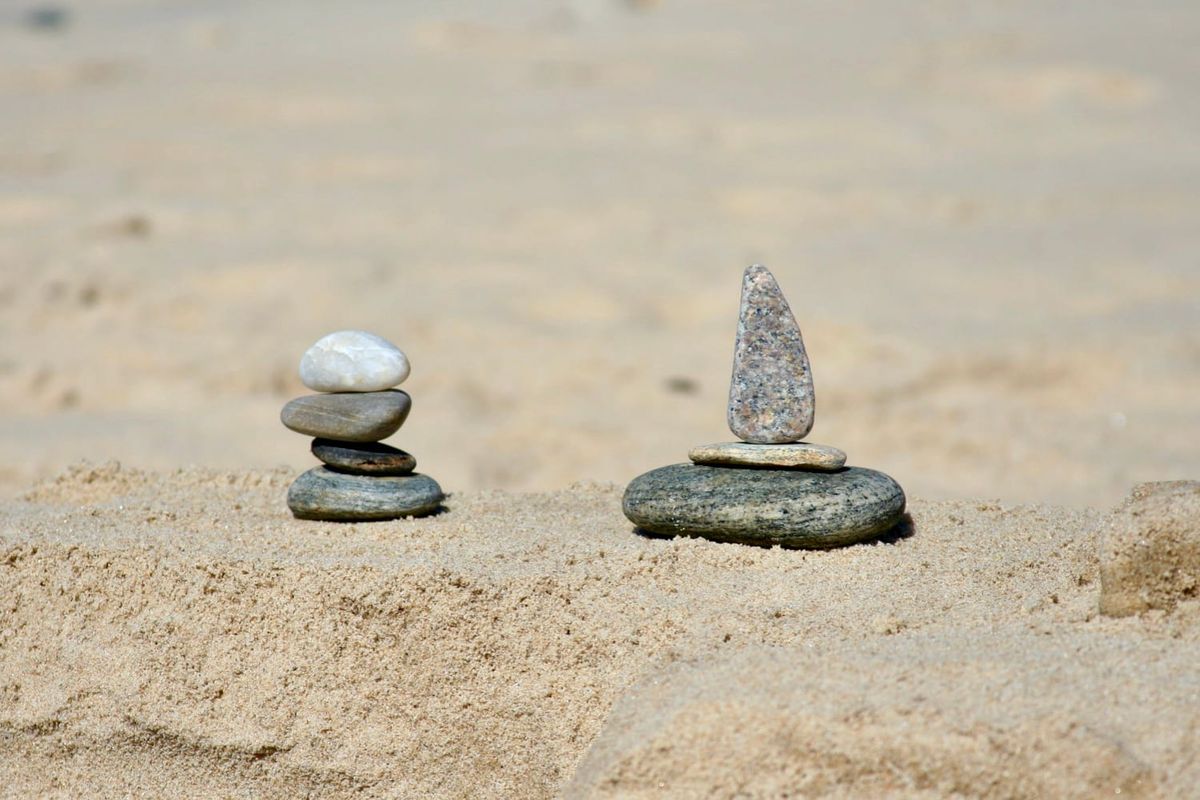
Another early mentor of mine often returned to the image of a stone and sand to describe the purpose of school and the values to which we should all aspire as teachers and students. She would explain that we should imagine carrying a stone in one pocket and sand in the other—the stone reminds us that we are each unique and valuable, and the sand reminds us that we are one of many. Both truths carry equal and mutually dependent weight, and school is where this lesson first takes hold.
Education is the entry point into the lifelong task of learning to value autonomy and interdependence in equal measure, not only in children’s learning lives but in the society they will inherit and continue to shape.
Our anxiety about individual outcomes and achievement often leads us to willingly let the sand drain from our pockets. But we can’t afford this loss. We need the stone and the sand.
Of course, it is important for teachers to honor individual differences, and the language of personalized learning often nods to this value. But when individual experience comes at the expense of community connection and relationships, both the student and the community suffer. By contrast, differentiation—the way teachers come to understand each child and modulate their support, so no one’s learning is sacrificed to the progress of the group—rests on the goal of meeting the needs of the individual within a collective context.
Personalization conveys something different. It pulls the walls of the classroom around a single learner, often moderated by technology, which is uniquely well positioned to shift our gaze away from one another. When we create tunnels of solitary tasks and achievements untethered from community, we may find that some learning moves faster. But I don’t think we can truly call these tunnels education. Personalization takes us out of the world. Education should always call us back.
As the sociologist Sarah Lawarence-Lightfoot has written, in her foreword to Carla Shalaby’s book, Troublemakers:
“We rarely hear the words freedom and love in our private conversations and public discourses on schooling, in our aspirations and hopes for our children’s education, in our proposals and recommendations for school reform…They tend to be blind to, and mute about, those powerful dimensions of classroom life that are shaped through intimate relationships, through community building, through honoring the rich variation and differences among us…The work is one of re-imagining what a free and loving learning place might be.”
We honor individual differences when we understand and welcome variation into our learning communities—when we make space for differences “among us,” as Lawrence-Lightfoot says, not apart from us. And we create schooling that benefits society more broadly when we offer children experiences that allow them to practice participating in something that is bigger than any one of us can ever be on our own. In every way, education should enlarge rather than shrink our perspective and our participation.
We are all always the stone and the sand.
The teacher Alicia Simba, reflecting on this question of care in learning beyond the preschool years, asks:
“What makes us think that teaching isn’t caretaking?...The work we do in the classroom around creating goals, checking for understanding, affirming students, these teacher moves and instructional approaches, they are ways of taking care of the young ones under our watch. Too often, given the negative and complicated historical legacies and contemporary conditions of childcare, teachers look to create a false separation between the two, when instead, the synonymity between the two could be stressed and expanded upon.”
Or, as my collaborator in humane schooling Benjamin Riley says, “Teaching is an act of loving grace.”
I want students, at every stage of their education, to know that their own learning and achievement are always bound up in mutual care and in a collective endeavor. I want them to experience learning as a form of care and connection—an act of loving grace, not an exercise in isolation. And I want to see the ripple effect of students carrying these learning experiences into the world beyond the schoolhouse walls.
I want us all to carry a stone in one pocket and sand in the other, and to promise not to let either fall away.
Wishing you experiences of learning as loving grace,
Alicia
P.S. Speaking of community care, if you've seen the cascade of candidates sacrificing trans kids in the home stretch of their election campaigns this week, I hope you'll take a few minutes to read this note from July — Let Every Child Play.
A few things I found helpful and hopeful this week…
- Why Calling Anti-Trans Hate a “Distraction” Is So Troubling
- More standing up for everyone, please. (Also, shout out to the brave student for asking the question.)
- Europe’s protests are about more than schools. They are a generational roar.
- The bird that changed Ecuador: how a chance discovery of a rare species helped to save many more
- Minnesota Goes to Space! — Minnesota's astronaut Anil Menon: From the North Star state to the stars