Just Some Rivers and Streams
Remembering Glen Hansard & thinking about how we model meaningful lives

“Now I let it fall back
in the grasses.
I hear you. I know
this life is hard now,
I know your days are precious
on this earth.
But what are you trying
to be free of?
The living? The miraculous
task of it?
Love is for the ones who love the work.”
~Joseph Fasano
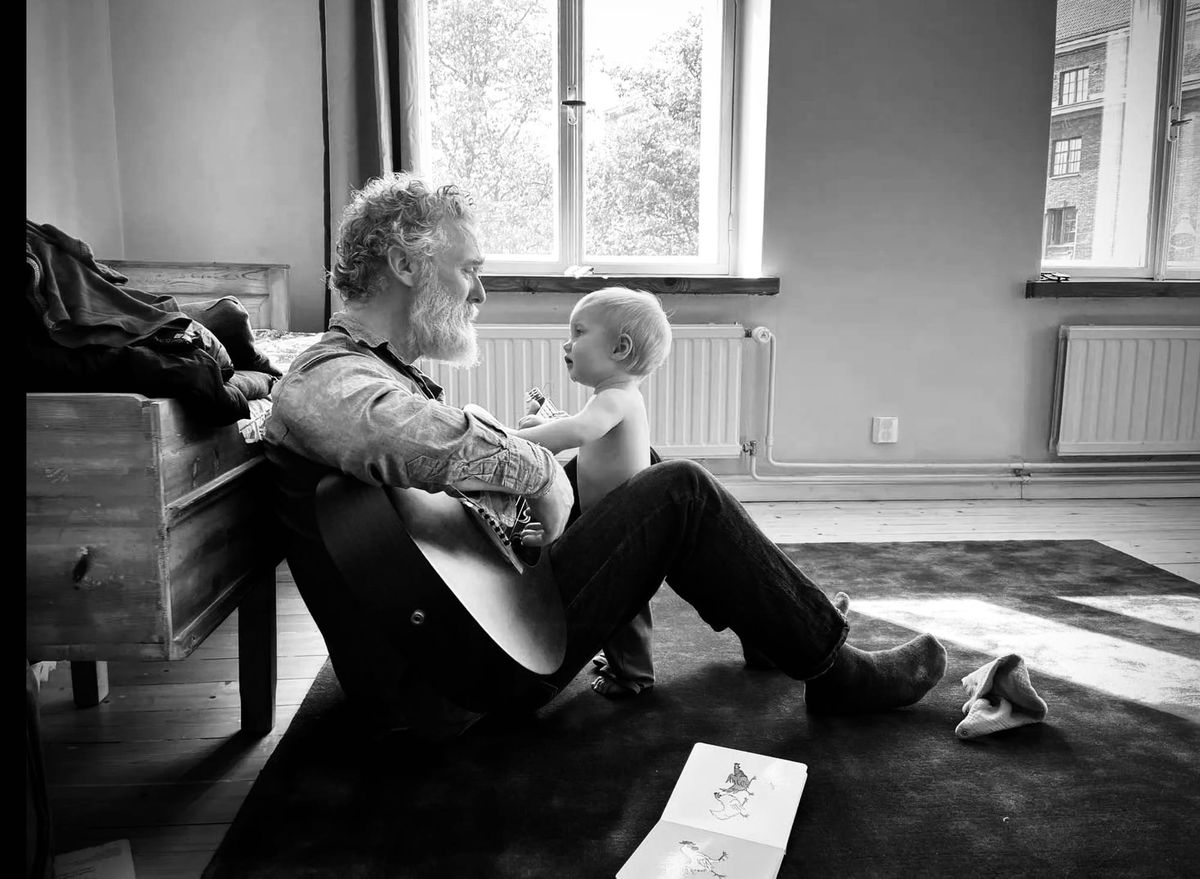
The musician Glen Hansard died in a motorcycle accident last week. Hours earlier he was sitting in a room full of other musicians and local community members, singing and playing his guitar with all the presence, intimacy, and heart that had made his music feel, for many, like a gravitational pull throughout his career. Hansard was extremely successful by many traditional metrics; he released over twenty albums, won a dozen awards including an Oscar, and performed on prestigious stages all over the world, often alongside stars like Eddie Vedder and Bruce Springsteen. He also never stopped performing in pubs, living rooms, and on street corners, continuing to define himself as a busker long after he needed to earn a living by setting his open guitar case on the sidewalk.
In nearly every interview over the years, he repeated a lesson he had learned in his early busking days—that other people only felt connected to his music when he was playing for the love of it, rather than out of a desire for an audience or even a need for money. People were pulled toward his music when it was sincere, when it came from his soul. They could feel the difference when the music was delivered as a product instead of as a heartfelt conversation. This was perhaps most evident when Hansard was playing with other people, as he was on the night of his death. Whether performing on a stage or sitting among neighbors, he encouraged singing along, was glad to accompany others, and clearly loved the messy, sometimes discordant, pleasure of improvising with as many voices and instruments as he could beckon to join in. His music wasn’t compelling because it was perfect; it was compelling because it was rough and imperfect and alive. It was in his openness, generosity, and desire for connection that we could feel his humanity and our own.
As an early childhood teacher, I’ve spent a lot of my professional time arguing for the importance of “process over product.” For young children, process is everything. Their language, their movement, their art, their early attempts at reading, writing, and making sense of numbers are all messy, in-the-moment experimentation. When we push children to demonstrate more fully formed, perfected evidence of knowledge and skills too early, we often curtail their learning and their creativity, trading depth of understanding for shallow mimicry.
As a teacher, I’m concerned about anything that mistakes output for thinking and learning. I worry about how children’s long-term learning and love of learning may be cut short by a fixation with short-term proof of narrowly defined skills. Anyone can be a good mimic, and children are especially talented at this, as they seek adult approval. But mimicry, fundamentally, lives outside the self. It is evidence of the world around the child, not of the child.
As a parent, my worry extends beyond the developmental role of process and exploration for young children. As a parent, I worry about how our fixation with products and outcomes has the potential to constrain a child’s entire life arc. I worry about the kind of life children, and all of us, lose the opportunity to live when we value production more than messy, soulful searching—more than the room full of imperfect voices singing together. I worry about what possibilities and depths we rob from them when we increasingly conflate ideas, art, and even relationships with consumable "content."
When I imagine the kind of life I hope my own son will be able to live, well beyond his childhood years, it is one of exploration, expression, meaning, and personal connection, not one filled to the brim with tasks and accolades in avoidance of empty space, or blearily observed from a dull distance through an infinite scroll.
I think this conflation of product and meaning, art and content, is at the root of Hansard’s observation that people connected more readily to his music when he was genuinely playing for the love of it. And I suspect it’s why he seemed to relish the sound of a room filled with the real, if imperfect, voices of neighbors and strangers so much. When consumption and achievement become the primary drivers of our creativity, our choices, our voice, and even the way we spend our idle moments, instead of expression and connection, I think we all experience some of the deadening that he described when he was playing for applause or for coins, instead of for the music itself, or for the urgency of the story he was trying to tell, or for the electricity of a conversation between his guitar and someone else’s heart.
It’s not that what we produce through our explorations doesn’t matter. It’s the song itself, not the mere idea of the song, that works its way into a listeners’ heart after all. We have to give shape to our thoughts, questions, and narratives if we want them to hold meaning for others, or even for ourselves. (And, of course, it should be easier for all of us to put food on the table, so we don't have to busk for coins to live.) But, ultimately, it’s the grappling, pulsing human behind the song that draws others in, not the mere plucking of chords.
Content fills an empty space. Its value, by definition, is in its quantity and volume. A sincere expression of life and story and soul, on the other hand, doesn’t just fill space, it creates bridges; it pulls us across time and difference, until we feel closer to each other, both more known and more knowing.
While it may be especially important to recognize the developmental significance of active exploration—of process—in young children’s lives, process isn’t a purely developmental need, unique to the growing mind of a small child. The human struggling, experimenting, striving, and stumbling beneath the final song, brushstroke, story, or discovery is what makes any expression pulse with significance and value.
There’s an ad I keep seeing in the subway for an “A.I.” company that visually compares two workflows. One is represented by a straight arrow, originating at an idea and pointing directly at the outcome of that idea. The other is a longer arrow that bends and meanders on its way from the idea to the product through twists and turns. Clearly the straight arrow, efficient and smooth, is meant to be the desirable path. But I can’t help but wonder what unanticipated discoveries might have been hidden in the twists and turns not taken. I’m not actually sure the arrows would, in reality, lead to the same destination. As much as the slick graphic tries to convince us that time and effort are all that’s at stake, a winding trail sometimes brings us to a view we couldn’t have imagined or anticipated. And, perhaps even more importantly, even if the destination is the same, there is often unexpected value in the detours we allow ourselves.

A few years ago, when my son was in middle school, he joined the band having, up to that point, always had an ear for music but never formally learned to play an instrument. I’ve written before about the transformative experience he and his peers have had together in their school band. Due in no small part to an extraordinary teacher, they have learned to play instruments they didn’t play before, to listen to one another in order to merge their individual instruments into music that is cohesive and coordinated, and to support and cheer one another on. They’ve developed new skills, performed for live audiences, and attended competitions. One could easily measure their growth and progress over the past few years by the difficulty of the pieces they can now play. In this sense, there have been many demonstrable outcomes of their collective labor.
But, if you were to ask my son why he has remained committed to the band, he would adamantly tell you that it has nothing to do with the performances or the competitions or even the annual trips they’ve taken. He is committed because of the people and because of the music. He has found pleasure and meaning and, in a very real way, a new sense of identity in the experience of learning to play together, of coming to think of himself as a musician, and of the camaraderie of the shared endeavor. He plays for the love of it and for the love of the others in the room with him, not for the spotlight.
The moments that I find most striking in the video above of Glen Hansard playing at his local pub in Dublin are the moments when he elicits those around him to join in—the way he turns his whole body to connect with the people behind him, and the way he nods toward others as he plays to signal that they are welcome to add their voices and their instruments. It is deeply apparent that the value, for him and for the others present, is in the energy circulating among all the people in the room through the music, not in the perfection of the song or in the adulation of the crowd. In that room that night, his music wasn’t currency, it was a current.
I think we all need more of this—not only young children, all of us—more time for process and for exploration, more opportunities to create for the love of creating, more openings for connection that is valued for its own sake, rather than measured by the metrics of clicks and views, and more permission to prioritize the discoveries that happen when we meander.
I hope you will find ways to sing for the love of it, whatever shape that may take for you, and to offer a life of such song to children. Don’t underestimate the beauty and the value of “the rivers and streams in between you and where you want to be.”
"Song of Good Hope"
Wishing you meandering journeys filled with heartfelt shared notes,
Alicia
A few things I found helpful and hopeful this week…
- We asked a first grader to interview his hero: A bird scientist
- Could a 'quiet car' work on the subway?
- Missouri Library Defiantly Holds LGBTQ Story Hour Despite Funding and Legal State Threats
- Group of rays spotted swimming in heavily polluted Newtown Creek: A sign of the waterway's path to recovery
- An important update on the attacks on Head Start