Stepping Over the Line Between Our Comfort and Active Care
Because it’s not enough to look for the helpers

“They mend; they stitch; they carry.
They work; they weep; they lose.
And when nothing can be done
among the rubble,
they kneel there as the fires fall around them
and they cradle the face
of the dying,
the life that is trying
to speak to them,
the life that whispers, listen,
and they do.”
~Joseph Fasano
One of the conversations I have most often and in the widest range of contexts centers on the idea that there isn’t really much distance between the challenges children grapple with and the challenges that test us as adults. Many of the struggles and lessons we associate with childhood continue to resurface throughout our lives, not because we are stuck or because we haven’t learned and grown with each iteration, but simply because we’re all swimming in the same currents for our whole lives.
There’s a popular discourse that positions this idea as a dialogue between our adult selves and our childhood selves, but this is not what I’m talking about. There is value to that framing, particularly with regard to addressing trauma. But it also relies on drawing a line between childhood and adulthood that is rarely as sharp as we may wish to believe. It’s not simply that we need to return to lessons that should have been resolved in childhood and tie them up, or soothe some former version of ourselves, but rather that there are some lessons it takes a lifetime to begin to understand and some that must be revisited over and over and over again.
It's no wonder, then, that we are constantly seeking comfort and reassurance. We all long to be steadied when we feel destabilized or unsure, whether we are four or forty or seventy four, and it’s understandable that, in these moments, we would reach for the familiar. When the world tells us that we’re not safe, it makes sense to feel a surge of childhood returning and to seek stability, soothing, and relief by recalling habits and mantras that calmed us then. It is logical that we would take refuge in words meant for a child during moments of precarity.
As a preschool teacher, I don’t actually think that this is a bad thing. Some of our most important and deeply values-based wisdom can be found in the lessons we try to instill in our children. We share messages with our children that we hope they will hold onto for a lifetime. So, I don’t think it's wrong or childish to return to those lessons ourselves as adults. In fact, I think that reminding ourselves of the values and narratives we hope our children will carry with them is often one of the best ways to reorient ourselves toward our core values and to regulate our most impulsive reactions. I often wish that adults would hold on more tightly to the lessons of the preschool classroom.
If we’re honest with ourselves, I think we often stumble on enacting these most basic lessons, as we become tangled in all the ambitions that our culture often tells us are more important, and in juggling all the responsibilities that drain us of the time and bandwidth to be our most caring, imaginative selves.
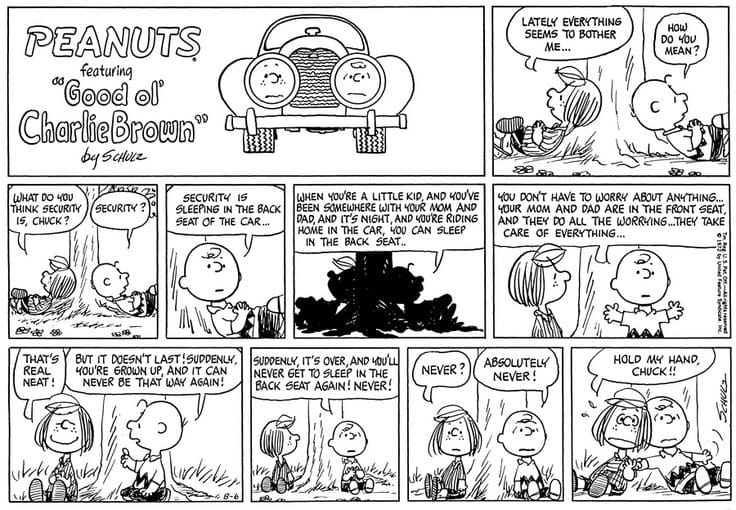
And yet, as adults, we do also have a different level of responsibility. It is good to revisit our most fundamental lessons, so we don’t lose track of them. But we have to do more. We can’t just allow ourselves to be comforted and then remain nestled in our own comfort. We do also have a greater responsibility than children do to act on our values and to do what we can to offer comfort and stability to others, not only to borough into the reassurances of childhood and remain there. While I don’t think it’s true that, as Charlie Brown once expounded, we can never experience the security of sleeping in the backseat of the car again once we’re adults, we can't stay there.
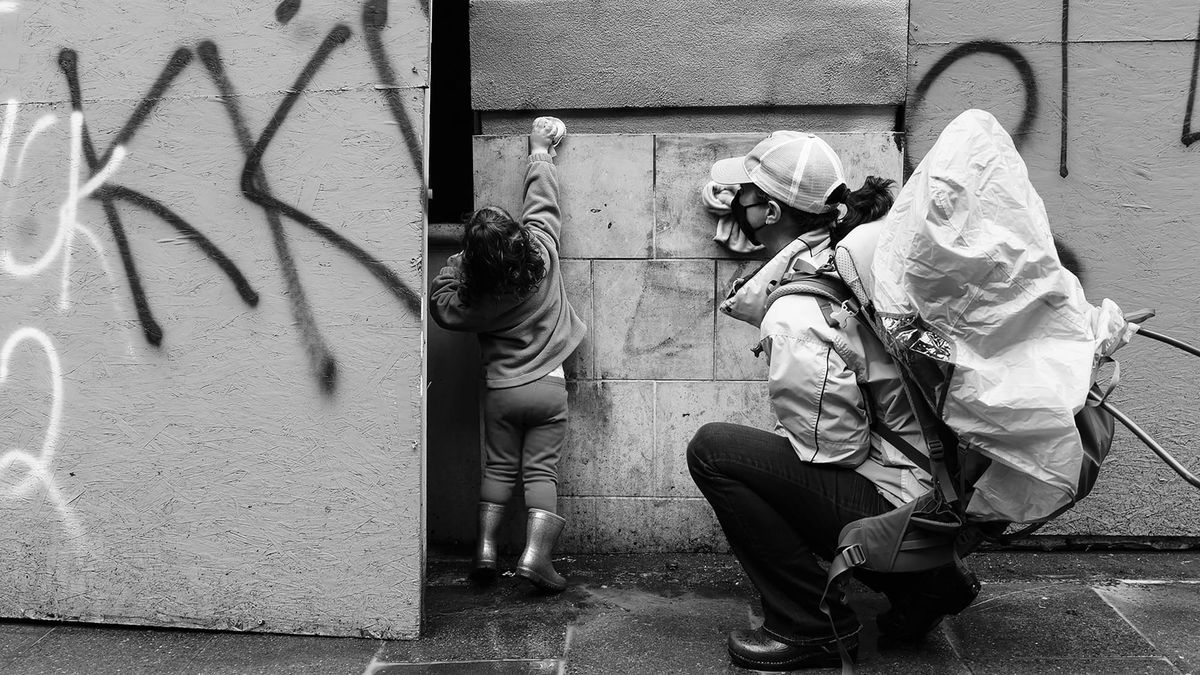
For all of these reasons, I sometimes hear legitimate frustration expressed at how adults have transformed that old Mister Rogers’ advice to “look for the helpers” into a panacea. In particular, I hear this frustration from those who are most actively engaged in the work of actually being the helpers—of addressing the most significant social and political challenges and of meeting the most immediate needs, which are too often left unmet by our social and governmental constructs. I recently read this comment and I felt the understandable exasperation of all the helpers who are constantly praised but much more rarely lent a hand:
“I’m getting tired of that Mr. Rogers’ ‘look for the helpers’ quote. I am one of the helpers, and I’m telling you that there are not enough of us.”
There’s a stark reality here that needs acknowledgement, even if it makes us uncomfortable—we need fewer passive observers and more helpers.
On the most basic level, it is important to remember that Rogers’ advice was meant for children. It was intended to offer comfort to a frightened child, when the world seems most out of control, so that they might be reassured by seeing that fear is not all there is and that there are grown-ups standing between them and scary realities. It was intended to remind children that wherever there is fear, there is also the potential for love and care. It’s okay, necessary even, for us to take comfort in this same message as adults, but there are additional layers that we are obligated to absorb as well, once we are no longer children.
Whenever we encourage children to look to the adults around them, there is also an embedded message about the power adults have to be models in children’s lives. The role of a model is not only to provide reassurance, but also to show children concrete examples of actions they might emulate. And, whenever this is our intent even in part, there is also an inherent call to become these models in their lives to the extent that we can, not only to point to them.
This doesn’t mean that we all need to be firefighters, staring down the most overt dangers each day, but it does mean that we are obligated to do our best to live up to the examples we are sharing with them. We aren’t called to be superheroes, but “helpers” should be a bar that most adults can clear, not only a trait we can showcase in others. In fact, I think it is often more powerful to show children how possible it is for each of us to become quiet, ordinary helpers in our communities, than to try to be superheroes. There is significant reassurance in an entire community of care embracing us—perhaps even more powerful than any singular hero can ever be. And this was also central to Rogers' larger message. In a video aimed at parents one year after 9-11, drawing on the idea of tikkun olam, he reminded us that we are all responsible for repairing the world, not only for seeking comfort from it.
Even for children, I don’t think that the intent in Rogers’ advice was ever merely to look to others for comfort. Certainly, children are not responsible for repairing the world all on their own, or for taking heroic actions that are beyond their developmental capacity. It is appropriate to allow them to be reassured by adults working to make the world better for them. But it is also possible for even the youngest children to offer care themselves and to become helpers in their own ways. And, if we look at the entire body of Rogers’ work, this theme of caring action is one he returns to again and again.

In a 2002 commencement address at Dartmouth College, speaking to graduates who were coming into adulthood in the wake of 9-11, he shared a story about children acting as helpers themselves, and he encouraged the audience to take inspiration from these children in their own lives. He described a race at the Seattle Special Olympics during which a child fell after starting the race and began to cry. Instead of continuing to run ahead, Rogers explained, all of the other children in the race stopped, returned to the child in tears, comforted him, and then linked arms with him so they could complete the race together. He concluded the story by explaining:
“Deep down we know that what matters in this life is more than winning for ourselves. What really matters is helping others win, even if it means slowing down and changing our course now and then.”
It is notable that he chose to tell a story to an audience of young adults and educators about children helping each other. It was not a story about grown-up heroism, despite the fact that he was speaking to an audience of those about to embark on their adult lives. Nor was it a simple message of comfort. He then implored that audience to follow this example themselves, to navigate life not only applauding helpers but becoming helpers. He ended his address by, again, translating advice that he often shared with children for an adult audience, calling for adults to live up to the lessons we offer children:
“When I say it's you I like, I'm talking about that part of you that knows that life is far more than anything you can ever see or hear or touch, that deep part of you that allows you to stand for those things without which humankind cannot survive: love that conquers hate, peace that rises triumphant over war, and justice that proves more powerful than greed. So, in all that you do in all of your life, I wish you the strength and the grace to make those choices which will allow you and your neighbor to become the best of whoever you are.”
Observing the helpers and finding comfort in them was only ever intended as the first step, even for children, in whom he clearly saw the capacity for active care, and especially for adults, who always carry a greater responsibility to step beyond comfort and to work to create a better world with and for children. And, at any age, it is often in doing the active work of helping, not simply in observing, that we are most comforted. Looking for helpers can steady us, and when we find them this also often allows us to see where we might begin our own work. But then we must actually take up that work for ourselves, for our children, for our neighbors, and for those already helping.
So, the next time you find yourself tempted to quote the adage about helpers, I hope you'll also ask yourself what you might do to join their ranks. How might you step out of the audience and join the children walking arm-in-arm? How might you begin to extend yourself beyond grateful observation and into helpful action?
Wishing you “the strength and the grace to make those choices,”
Alicia
A few things I found helpful and hopeful this week…
- A wonderful speech by picture book author and illustrator, Jon Klassen, on fiction, art, children, connection, and living in disastrous times with meaning and care. You should really listen to this one.
- From Cell to Cell, Jailed Minnesota Unionists Sang of Freedom
- Support the legal defense fund for MN anti-ICE organizers, whose costs could easily soar into the millions. If you don't know about this case, you can read about it here.
- Another way out: Don’t plan a future that fails the present
- How renting a sewing machine from the library can improve democracy
- The United, Not Synonymous, States of America