Walking the Same Paths Every Day
What children know and grown-ups forget about revisiting familiar places

“The song you heard singing in the leaf when you
were a child
is singing still.”
~Mary Oliver
I recently discovered that I can walk to work through the park in just slightly more time than it takes me to get there on public transportation. I’m not sure why it took me so long to realize this, but it has shifted more than my commute. My entire day feels a little lighter when I begin and end it among the trees and birds.
When I was regularly working from home and had more control over the hours of my days, I spent a lot of time outside. In the morning, I would walk through the park with my son on his way to his school and then back home, before starting my own work day. These morning walks fundamentally changed the mental framework I began work with. I’ve never been a morning person—a particularly tricky thing when I was still a classroom teacher, especially a teacher of bright-eyed, early-bird, preschool children!
So, starting the day in motion and being awakened by the fresh air made a big difference, even when it was uncomfortably humid or when the frigid winter wind whipped through us from across the river. I found that I was not only more alert, but also steadier, more capable of reflecting before reacting, and more at peace throughout my days. Sometimes, if I was tussling with a sticky problem or trying to generate an idea that wouldn’t quite come, I would head back outside to shift the gears of my mind. Rediscovering a little bit of the regulation and quiet of walking among trees and birds each morning, amidst our otherwise loud, busy city, has been enormously beneficial these past weeks.
The exposure to nature, even in the somewhat artificial way that it exists in pockets of urban life, is certainly part of the regulating power of these routine walks. There’s lots of evidence that nature has a profound impact on our mental and physical well-being. And, surely, walking instead of riding on a crowded train or bus is a factor, too.
But I think there is also something in the power of repetition—walking along the same paths and past the same trees and the same ponds every day. Sometimes routines make us blind to the details around us. We stop looking closely, because we think we know where we are, shifting into an automatic mode and seamlessly filling in the gaps in our senses with memories from other days. Sometimes, though, revisiting the same places again and again allows us to do the opposite, to look more closely and to notice the small things that go unobserved when an environment or an experience is new.
The familiarity offers practice in sensing changes and in appreciating what might otherwise remain hidden. In nature, this recursiveness also provides a reminder that, despite everything, life persists. The summer ducklings are now indistinguishable from the adult ducks on the pond, and the magnolia blooms are long gone. But there’s a barred owl visiting the ramble, and a monarch butterfly flits across the grass as it begins its migration south.
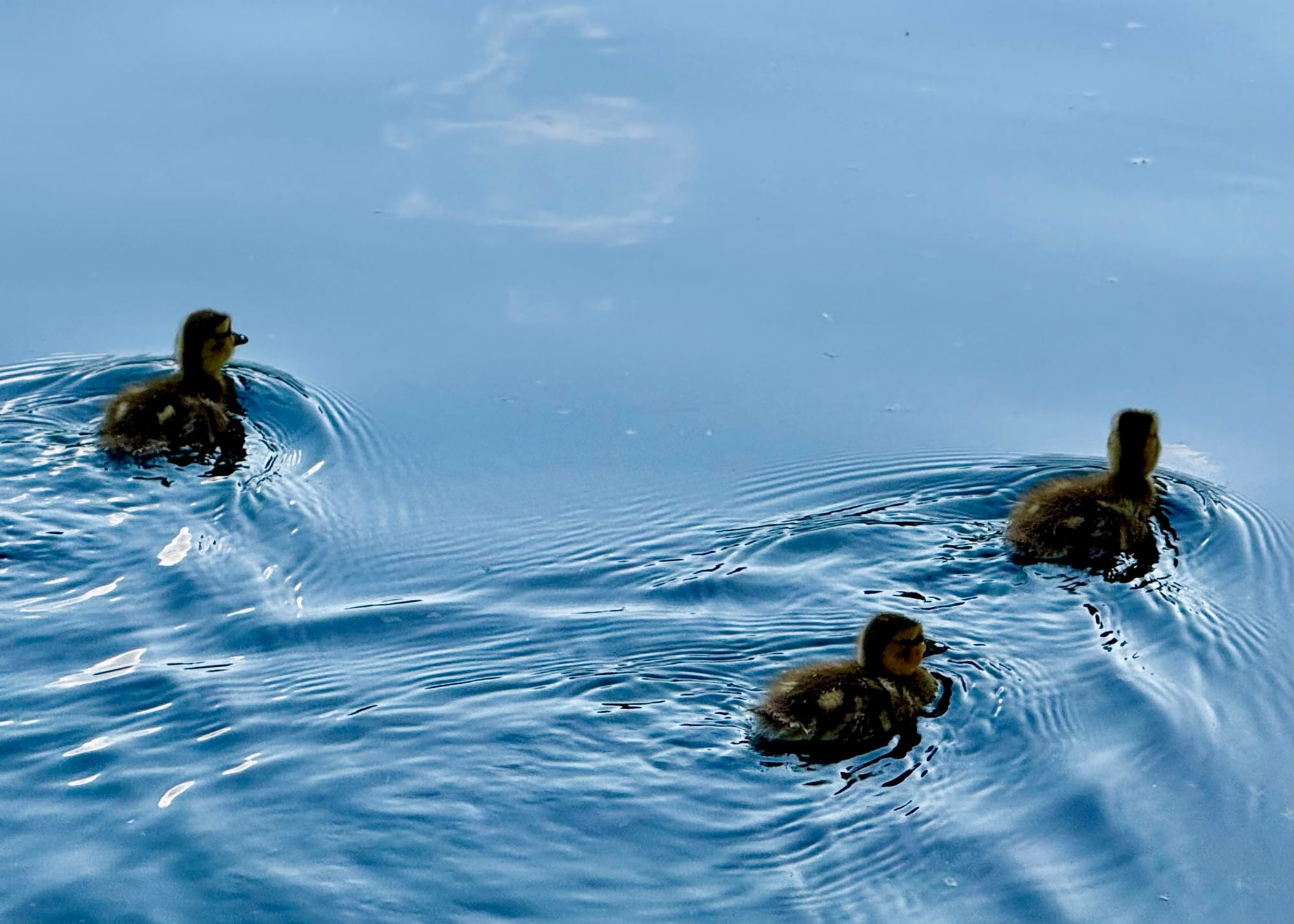
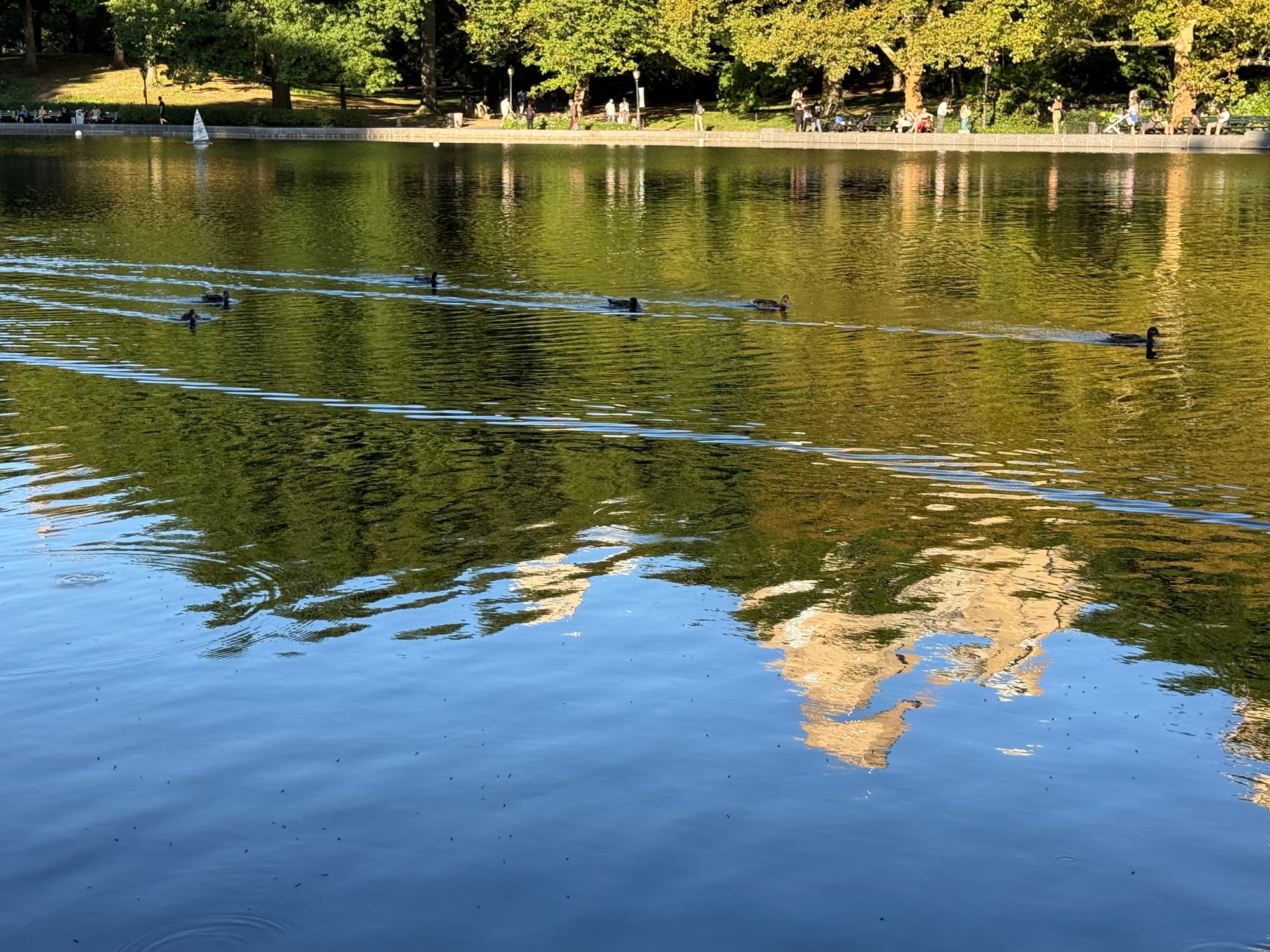
The ducklings of August are almost all grown up.
Young children intuitively understand the power of repetition and the recursive learning that unfolds only when we go back again and again to the same wells. Any parent who has read the same book countless times or sung the same song over and over knows this. There is comfort and reassurance in familiarity. And, of course, repetition is also helpful in embedding ideas and information in memory. But this draw toward repetition isn’t just about ease or rote memorization for a child. Children also make new discoveries each time they return, looking more closely and searching for small changes or new bits of information in the landscapes of texts, illustrations, melodies, and favorite places they know well.
Cognitively, this is an important dimension of learning. Novel experiences exhilarate our senses, but this exhilaration also casts a wide attentional net. Return nudges us to focus, to study, to make our knowledge and our understanding more intimate, particularly when we don’t only repeat all the same motions verbatim but intentionally continue to engage the exploratory capacities of our mind, even as we retrace routine routes.
The loss of this recursive knowing is something I worry about for both adults and children in the face of the constant drumbeat of efficiency and acceleration. When our goal is always to accomplish more in less time, we are accordingly less able to benefit from the unexpected discoveries and understandings that emerge from meandering. But we are also less likely to revisit the places we’ve been before. If every experience, whether in children’s school days or in our own adult lives, is merely a checkbox ticked off that allows us to progress to the next check box, it grows harder to justify carving out the the time to tread the same paths over and over until our knowledge of them runs deep in our bones. The curiosity we hold for new details and small changes in the familiar is more tender than the curiosity that washes over us when we rush headlong into the new. It’s an inquisitiveness that emerges from a kind of love, nourishing our feeling of connection and belonging, rather than the more exciting but cursory tourism of novelty.
When my son was younger, we visited the same museum exhibits over and over again. Not only did this never become boring for either of us, it provided a unique balance of soothing routine and constantly deepening attention. Once, when he was around five or six, he overheard another museum visitor wonder aloud about a display of bird and dinosaur bones, and my son piped up to explain to this adult how the structure of the air pockets is a clue, nodding toward flight. His understanding and his confidence in sharing what he knew were the result of the close attention and nuanced knowledge that emerges only from many hours of returning to the same explorations again and again.
In an interview about her work, Mary Oliver said, “My own nature is to walk the same path every day to see what I missed the day before.” There is a peace to walking along the paths we know intimately, whether they are literal paths, books we are drawn to read and reread until we feel we know the characters like we know our own friends, or questions that we can’t stop turning over in our minds. The places, people, and ideas we revisit become part of our own mental and emotional pathways. There is a depth of understanding we cannot reach in any other way but to return and return—to places, to questions, and to each other.
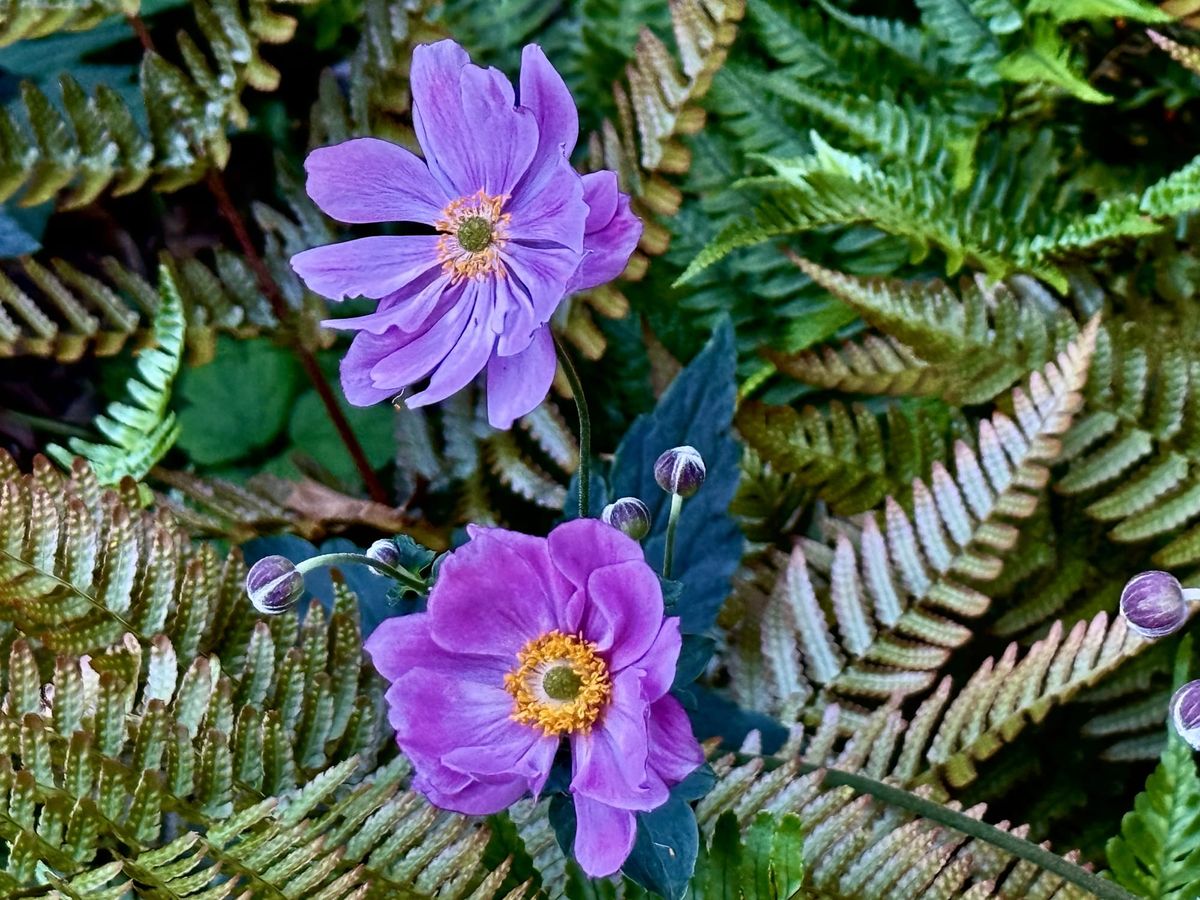
Last week, on one of the mornings I walked through the park, I was struck by the creeping emergence of fall. Even though the hot, humid air still hovered, the leaves were suddenly beginning to yellow and the bursting color of the summer flowers was all but gone. Then, as I turned a corner, a cluster of bright white Japanese anemone flowers bobbed on their long stems. The petals glowed in the morning sun. I was sure they had not been there just a few days before.
On that morning, I was fresh off the news of the friend I wrote about last week, and my spontaneous initial thought was that she was winking and smiling at me from this unlikely array of early fall blooms, with their gentle blossoms waving in the light. This isn’t the way I usually process loss or think about mortality. Though I gravitate toward metaphors in general, I usually approach death with a more scientific acceptance and a sense of finality. Yet, on this morning, something about the familiarity of the trees and the early light allowed me to be struck by the suddenness of these new petals, dancing in the breeze and leaning out over the path. I’m sure I would not have noticed them in the same way, or attached the same poetry to them, if the rest of the route had not been so well known.

I want these kinds of moments for all of us and for our children: the comfort that comes when we allow ourselves to be bathed in the ease of familiarity; the specific curiosity and depth of knowledge that emerges from looking closely and repeatedly instead of always rushing ahead; and the potential for serendipity, and maybe even a little magic, that is possible when our minds are attuned to the smallest glimmers of the unexpected within the known.
Wishing you the wisdom to revisit old paths and the patience to allow children to do the same,
Alicia
A few things I found helpful and hopeful this week…
- Saved by the Beauty of the World - Speaking of Mary Oliver, this documentary about her life is really wonderful
- Let Us Eat Cream-Cheese-Cucumber-Tomato-Sandwiches, on Rye Bread - A lovely essay about reading and our tolerance for complexity by Emily Wilson, with a special appearance by Frances the Badger of Bread and Jam fame!
- The opposite of the apocalypse is a neighborhood - Maybe my favorite take on this week's AI meltdown is from Garrett Bucks, mostly because it's not really about AI, it's about us. Let's talk more about us.
- Annie Dillard and the Writing Life - A beautiful essay on writing and teaching and learning from Alexander Chee
- A floating children's library!