We Gather Everywhere
Because community is for everyone

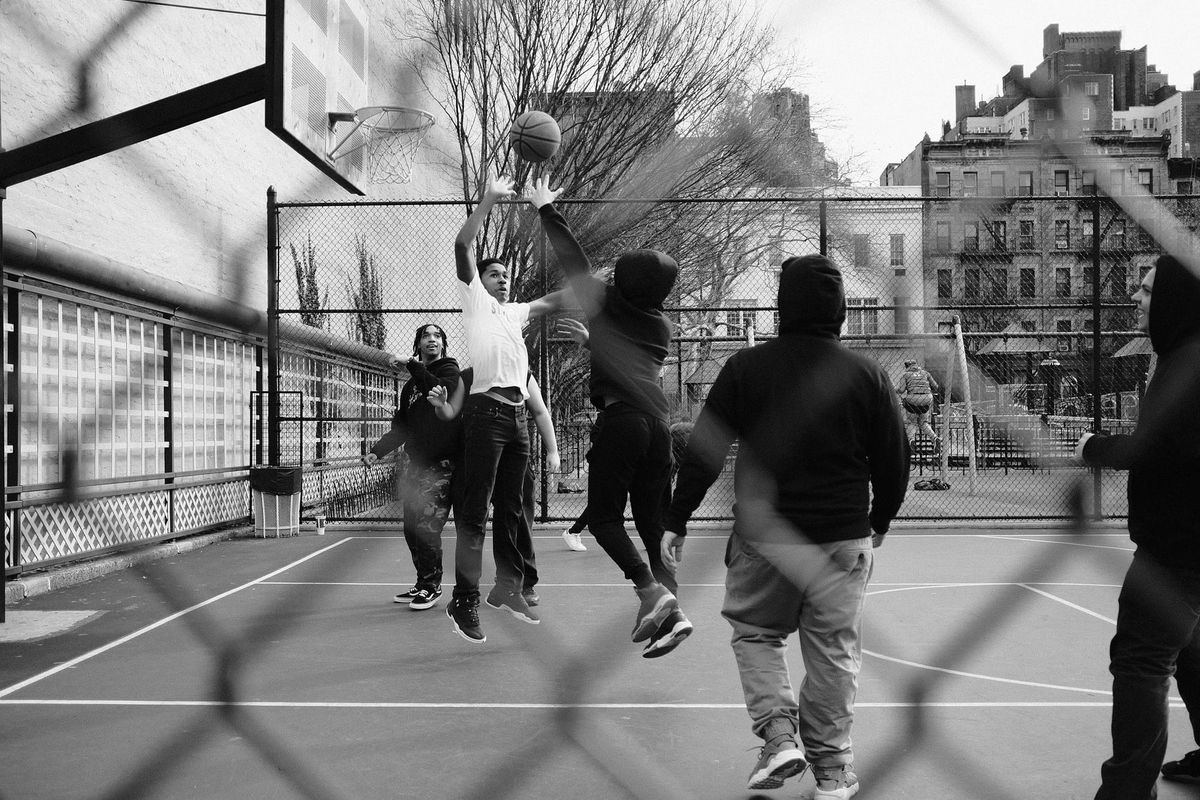
“But look: my niece is running through a field
calling my name. My neighbor sings like an angel
and at the end of my block is a basketball court.
I remember. My color’s green. I’m spring.”
~Ross Gay, from “Sorrow Is Not My Name”
I’ve spent my whole life going back and forth between New York and Minnesota. I identify with both places, but for the most part they don’t really identify easily with one another. I’ve spent many conversations trying to convince New Yorkers that Minnesota isn’t what they think it is, and many more trying to convince Minnesotans that New York isn’t what they think it is.
I’ve tried to explain that “Minnesota nice” is not the superficial, passive-aggressive politeness that New Yorkers often assume, but rather a deep sense of neighborliness and mutual interdependence. I think people have finally started to understand this over the past six months, as Minnesota’s dedication to interdependence became a national example of community care at its best and most essential.
On the other hand, I’ve also tried to explain that New York is safer, more caring, and more filled with its own sense of neighborliness than its reputation belies. As a friend once noted, we were never lacking for a backyard growing up in New York, because we had hundreds of parks and playgrounds to choose from—we just had to share them with the rest of the city. There is something uniquely formative about growing up in a place where every aspect of daily life is marked by shared spaces and shared resources.
I do worry sometimes that this experience of New York is fading. As wealth has increasingly dominated more and more neighborhoods, private spaces have proliferated. Members-only community hubs, work spaces, and play spaces for children seem to pop up on more corners every week. And, meanwhile, the decreasing number of truly local businesses, leaving behind stretches of empty storefronts, has left visceral gaps in the fabric of our urban interdependence. As rent has skyrocketed, online business has dominated, and tax loopholes have made it more profitable for landlords to keep properties vacant, it can feel like the web is fraying. And yet, the public parks and playgrounds and libraries remain, and the subways and buses, as much as we complain about them, still stitch the boroughs together. We have to fight for these resources. They are never guaranteed. But those that persist continue to overflow with life nonetheless.
I think this is part of why all the images of New Yorkers gathered around make-shift TV screens, propped on folding tables outside bodegas, and projected against sheets and brick walls on city streets, as all of New York became collectively fixated on basketball over the past several weeks, has felt so powerful. It has been a vivid reminder that community can take shape anywhere, and that the unique texture of New York’s gritty, resilient, diverse, necessity-is-the-mother-of-invention, cobbled together, street corner community still exists in abundance.
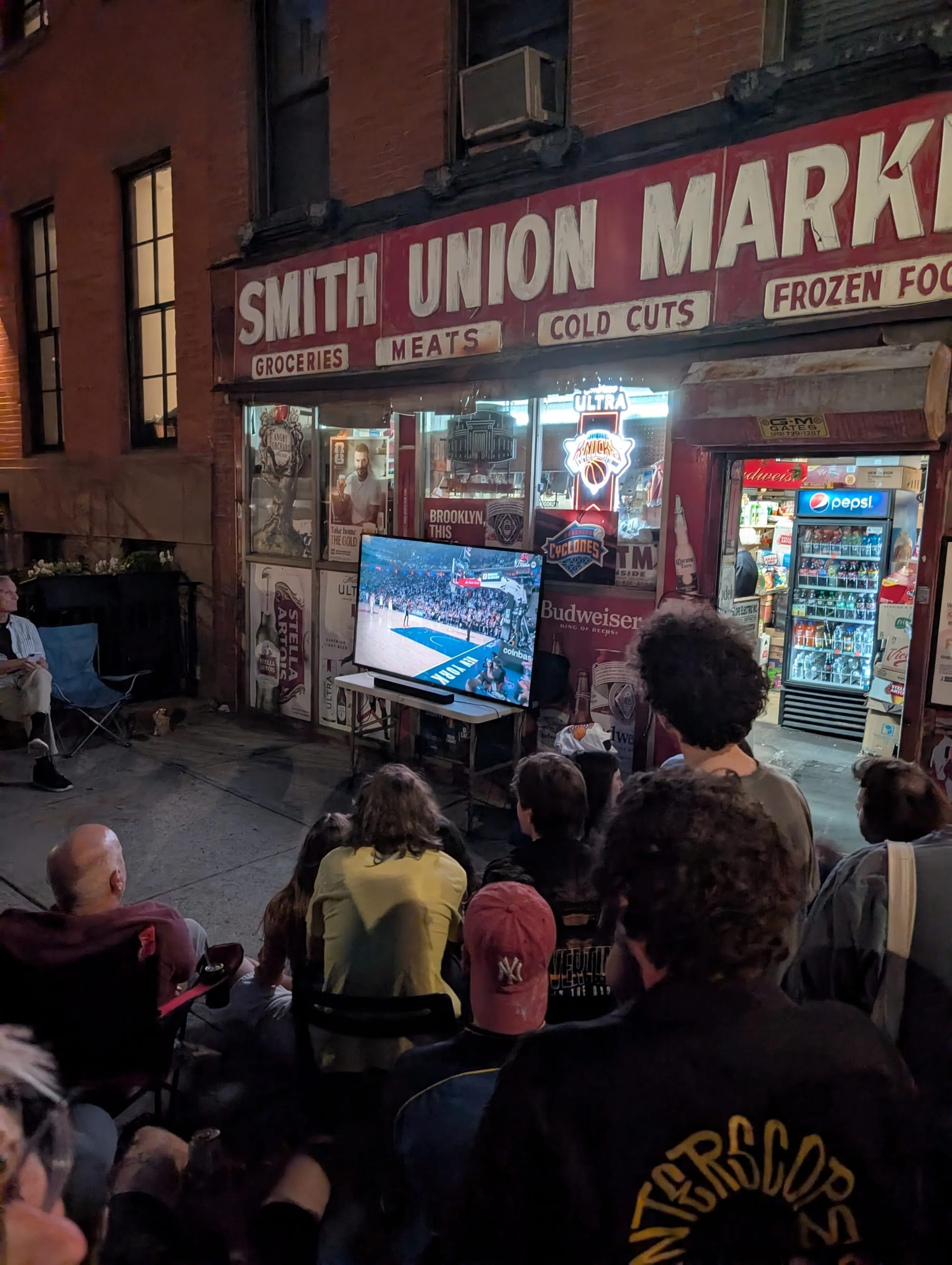
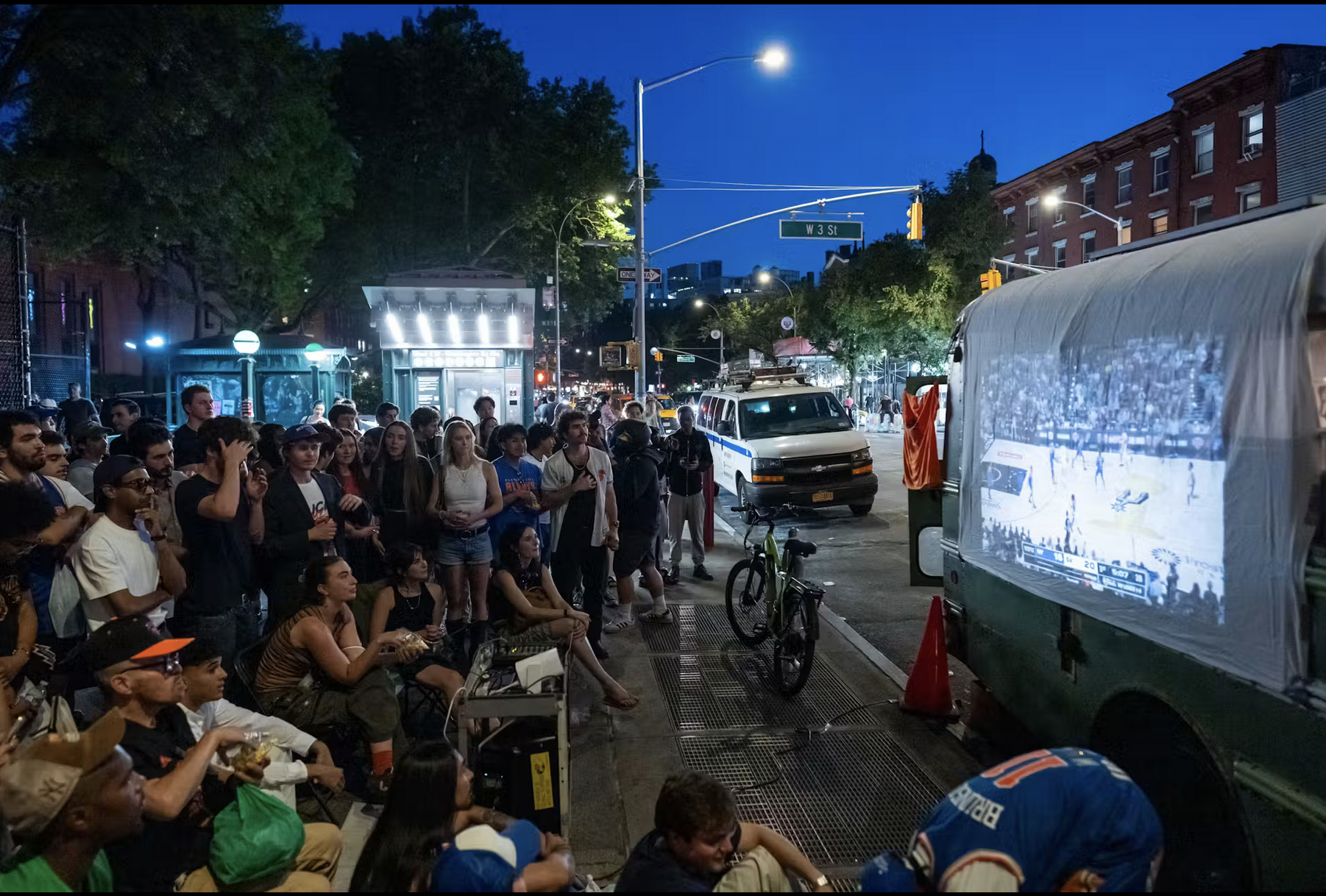
Photo of Smith Union Market by Juliet Shen; Photo of West 3rd Street by Alex Casto
Having spent so many years moving between the kind of community that takes shape in the Midwest and the community found on the stoops, in the parks, and outside the bodegas of New York, I know in my bones that there isn’t just one way to come together or to care for each other. But I also know, from seeing community at work in these very different places, that wherever and however we manage to gather, it’s always powerful.
All the debate about whether we are irreparably divided has always seemed a little silly to me as a result. Of course we’re divided. I’ve seen and felt the fault lines, sometimes deep and entrenched, moving between these very different places. The precise nature of those divisions—how extreme they feel and whether they seem more polar or more subtle and multifaceted—these nuances shape shift over time. But I’m not sure it would be possible for so many people, spread across so much geographic distance, with so many different points of origin and localized traditions not to be fractured in many small and large ways.
These differences surely matter, especially when they pit us against each other. But maybe whether we have the ability to gather together and connect with each other wherever we are, whatever the particular tone and flavor of our unique point in time and geography might be, and whatever differences might exist between us, maybe, just maybe, that ultimately matters even more?
When I wrote about how teachers understand community a few weeks ago, I mentioned an organizing meeting I’d attended in New York back in February in which people worried aloud that New Yorkers couldn’t do what Minnesotans had done for each other, because we don’t have the same fabric of neighborhood connection and care woven into our daily lives. The nature of our connections in New York is certainly not the same. We’re a much bigger and more complex city, and we relate to each other differently. But the past few weeks have reminded me that, though it may look different, we do, in fact, know how to gather around each other here, too. We know how to share our resources, and we know how to invite each other in.
When I think about what community looks like in New York, I sometimes recall a small moment when my son was around three years old. We were crossing the sidewalk to head into our apartment building in West Harlem on a hot summer afternoon when a man on rollerblades came racing down the sidewalk from the opposite direction. He narrowly avoided crashing into my son, averted only by the fact that I’d grabbed his chubby toddler hand and pulled him backwards, just as the rollerblader simultaneously veered away from us. Everyone was okay, but the man on skates had barreled into the scaffolding and surely sustained some bruises, and he was annoyed. He whipped around and started to yell at us for getting in his way. My heart raced with the flash of adrenaline at what had almost happened, as I held my son’s hand and took in this stranger’s anger.
But then, as he shouted, two older Dominican men, who had been standing in front of the entrance to our building, charged over to the man and admonished him, as only a grandfather can. “You almost hit the baby! You should be apologizing. You need to be careful. There are kids!” A third man came over to us to check on my son, who was barely aware of how close he’d come to being seriously injured. Meanwhile, the kind Russian woman who managed our building also stepped out to check on us. It was a brief moment of daily life in a busy city. But it has stuck with me over the years, because it felt emblematic of the way we are capable of standing up for each other and caring for each other, even across differences and even in a city that moves so fast it can leave our hearts racing and our vision blurred.
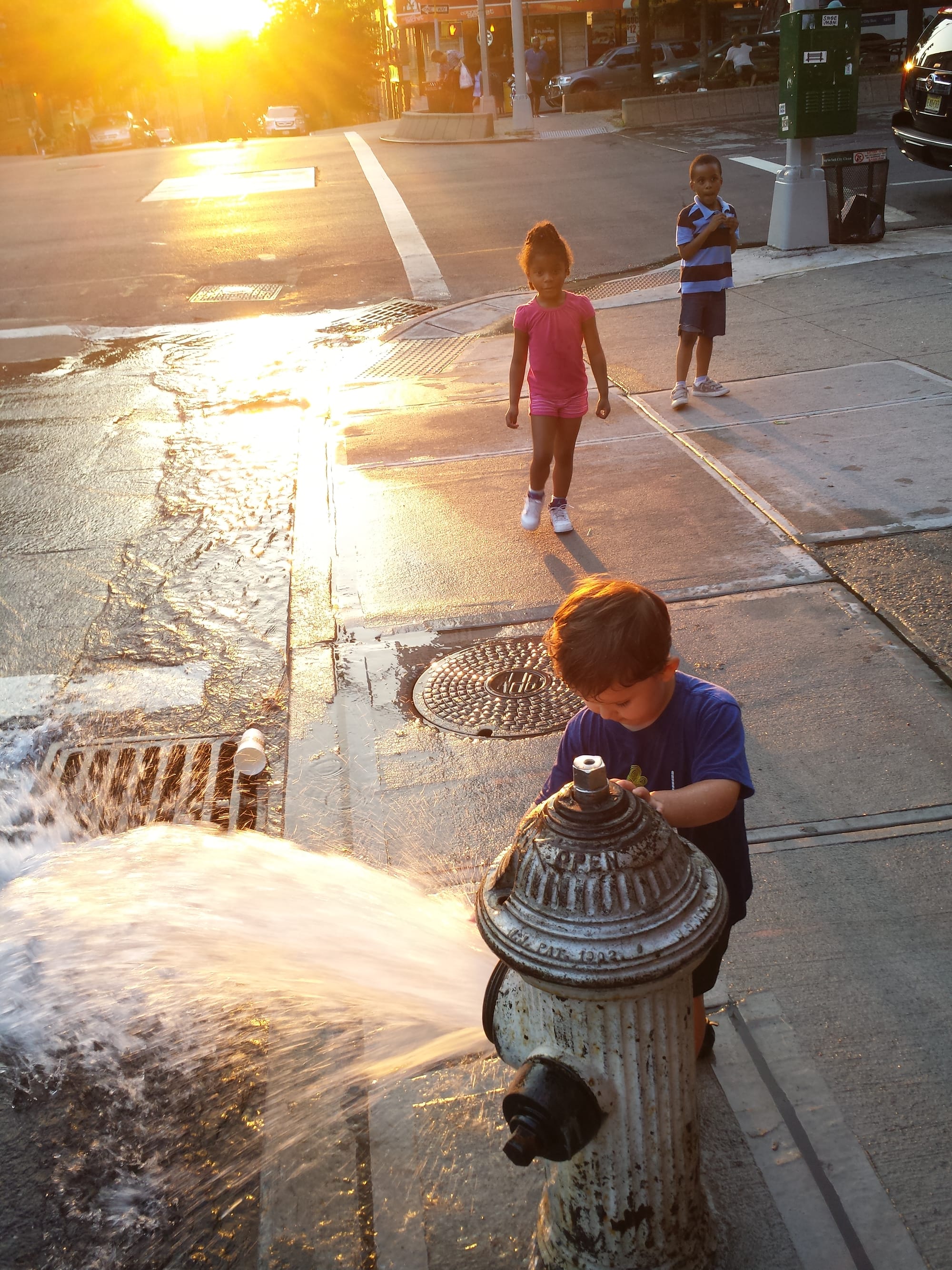
The last couple weeks have felt filled to the brim with moments like this in New York—moments that have reminded those of us who live here, and hopefully people watching from afar, that we are still capable of coming together and sharing space, resources, purpose, and joy. We’re still capable of looking out for one another and of celebrating together. All the watch parties and celebrations have felt like more than a response to the long-awaited achievement of a sports team. They’ve also been a raucous validation of the unique bonds that take shape when a common goal and a sense of connection weaves itself through an array of wild and eclectic differences.
When I wrote about community in Minnesota a few months ago, I mentioned the knitting shop my cousin and her husband own, where neighbors come together for classes and craft circles. I wrote about this as an example of how empathy develops over time, amidst the small, shoulder-to-shoulder connections of mutual activity. I think this is the kind of connection New Yorkers sometimes worry we may not have here. It’s easy to forget, as we race past each other on the street and jostle in and out of sweaty subway cars on an average day. But I think this is also one of the reasons I found it so fitting that, among the many videos and images that circulated last night of New Yorkers celebrating, one of the most widely shared was of a man in a Knicks jersey, Ramell-Correen Frederick, sitting outside at an industrial Singer sewing machine, embroidering custom items for strangers on the street. Perhaps the activities that bring us together aren’t so disparate after all—sports, music, colorful thread.
Matt Flegenheimer wrote of the energy and camaraderie that engulfed New York over the past few weeks and especially last night:
“It would always be different here because New York is its own thing — for its size, its breadth, its indomitable self-regard — a city experienced maximally, in close quarters, for those fortunate and masochistic enough to try…It is different because, for all its mashed-together brilliance, so little about this city is felt universally: It is rich and broke and Mets and Yankees and pitiless and bighearted and enormous and never smaller than it has seemed lately…It is different because New York’s mass unifying events tend to imply unbearable tragedy: 9/11, Sandy, Covid.”
I think all of this is true. Every place is unique and carries its own history, its own form of celebration and mourning, its own memories of trauma and of joy. And New York is, perhaps more than anywhere, a city filled with contradictions that easily pull us apart and make us brush past each other. But it is also a city that can feel surprisingly like a small town when we do come together in a shared spirit, whether through suffering or through jubilation. And there is something uniquely beautiful about the unlikeliness of such diverse camaraderie when it materializes.
As I scrolled through videos and photos of ecstatic New Yorkers last night, I was also struck by how similar many of them were to those that circulated of defiant Minnesotans, under vastly different circumstances, just a few months ago—brass bands and drummers in the street, people of so many different backgrounds singing and chanting and dancing together, a man with a sewing machine weaving a community with literal thread.
Despite very different circumstances unfolding in very different places with different histories and rituals to bind people together, there was something moving about the overlay of images. Ultimately, wherever we are, we find ways to gather and to carry each other along, whether through grief, joy, defiance, or all the small, sometimes heart-pounding moments of day-to-day life. We find ways to share space and to share our hearts.
Wishing you threads of connection and care wherever you may be,
Alicia
A few things I found helpful and hopeful this week…
- The thread. with the original photo by Dr. Steven Thrasher, that made the Knicks' embroiderer, Ramell-Correen Frederick or "Cheeks," a very New York sensation
- And the artist's website, where you can learn more about the him
- A Bookstore Boom in a Time of Literacy Decline
- Everyone Wants to Think They're Open-Minded
- Astronaut Victor Glover is still trying to find the spiritual words to describe his Moon mission
- “We Demand Justice”: A Letter from the women of Delaney Hall
- Kids testifying for public library funding