Teaching, Parenting, and Resisting Inevitability
Reflections on two years of writing toward hope


“Do you remember when we were kids,
running down the hill,
not knowing if our legs could carry us?
That is how you must continue.
Wildly, wildly,
unafraid of what will surely come.”
~Kate Baer
This weekend marks two years of writing toward hope, and most days I still think about Notes on Hope as an experiment. I think of these notes as an experiment in the power of definitions, of what happens to our capacity for action when we refuse to define hope as passive, but instead as an insistence on our ability to change the course of the future, and on holding ourselves accountable for the work that this insistence demands. It is an experiment in a version of parenting and teaching that locates this active definition of hope in honesty, asking what new possibilities we might unlock in our children and in their future when we stop trying to hide the unsettling realities of the present from them. It’s an experiment in learning from and being motivated by the potential of the future, instead of by the seeming certainties of the present—of considering our own attitudes and actions within the light of the imagined world we wish for our children, acknowledging that this world does not yet exist. And it’s an experiment in listening to, learning from, and being motivated by the light of children’s own imaginations, which are so often bolder and braver than ours.
I continue to think of all these aims as experimental, because hope is always precarious and requires recommitment each day, and because hope involves working toward something we can’t yet fully see or know.
In some ways, it feels like the world has changed dramatically in the course of these two years of writing, and plenty has happened that could certainly provide reasonable evidence against the strategic value of hope. But I think that’s too easy an explanation of our current reality and too flimsy an understanding of hope. Those who were vulnerable two years ago are much more vulnerable today, but they are not newly vulnerable. Acknowledging this is critical to our ability to discern both how we got here and where we might go. These two years have provided a stark reminder of just how intermingled the past, present, and future are. And they have forced us to reckon, once again, with the reality that the arc of progress does not bend in a guaranteed direction, or even in only one direction at any given time.
It is difficult to live, and especially difficult to raise children, amidst circumstances that don’t allow us to envision unbreachable walls separating the darkest periods of history from the present, and that don’t allow us to presume that progress inherently flows toward more abundant freedom and dignity. And yet, it is only in reckoning with these uncomfortable realities, and with the uncertainty of time and change, that the better future we may have thought we were already moving toward is still possible.
In the first Notes on Hope post, I wrote about this draw to protect ourselves and our children from difficult realities:
“As our news feeds blast crisis after crisis, it is tempting to approach the task of parenting as though we are building impenetrable domes around untouchable lives for our children, constructing beautiful fortresses in which the vibrancy of the grass on a soccer field, the handpicked selection of books on their shelves, or crisp A’s on a report card might distract them (and us) from the curvature of the dome and the turbulence of the skies beyond. Yet the dome must inevitably crack, as lightning illuminates the world they will inherit, despite our best efforts to paper over fractures in one-way glass.”
Though we may convince ourselves that we are creating these glistening domes for our children, we really create them to protect ourselves from our deepest fears, which are brought especially close to the surface of our consciousness by our love for them. The cracks have only grown wider since I started writing, as any vulnerability in our own identity, our children’s, or our neighbor’s has come under increasingly imminent threat. It has gotten harder and harder to avoid seeing the depth of these fissures, or to conceal them from our children.
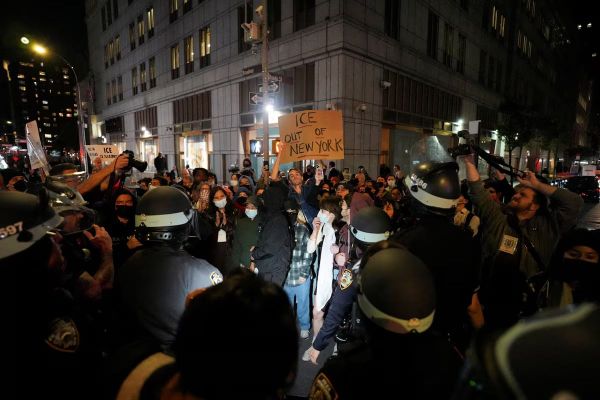
As I wrote during the Metro Surge in January:
“When their schools are under attack and their friends’ parents are disappearing, it is impossible for even the youngest child to fail to see the reality, which is that sometimes even their most trusted caregivers cannot protect them…It feels like a personal failure when we know that, as adults, we might not be able to succeed at protecting children. And it certainly is a social and political failure that we can’t. Nonetheless, here we are. So, what are those of us who care for children to do when we know—and they know—that we may not be able to keep them safe, because some of the most powerful people in the world don’t see their young lives as worthy or valuable, and whose rage and greed is fixated on their small bodies, on their families, and on their schools.”
In some ways, it is more challenging to feel hopeful and to write about hope under these circumstances. However, if we understand hope as an active insistence rather than a passive state of desire, then this is precisely when it is most important to commit to hope and to offering hope to our children. We don't do this by denying reality but by embodying the version of the world we wish to see take shape, and by lifting up others who are doing the same. Even as fear has grown more pervasive, I have also found that it has become easier and clearer to locate these concrete examples of hope in action.
Just as examples of cruelty have become more obvious, examples of ordinary people acting with courage and compassion have also become more obvious. We don’t have to reach for abstract metaphors or historical figures to show our children what actions rooted in an insistence on their humanity, on the humanity of others, and on a more just and compassionate future look like. Examples are all around us—examples of real people, putting themselves at risk to care for those who are at greater risk and refusing to accept cruelty as unavoidable or unstoppable.

I’ve written repeatedly over the past two years about the idea that hope isn’t the opposite of fear or of pragmatism but of despair. Hope is the motivating force that pushes us to keep working toward something better, instead of sinking into the feeling that nothing can be done. More specifically, I’ve come to think of resisting despair, and of the insistence on possibility that hope demands, as a refusal to accept narratives of inevitability. Whether we view inevitability through a lens of optimism or pessimism, it projects a certainty that drains us of agency and imagination, and in turn of hope, even when it is meant well.
My ears have become perked to language that claims inevitability, regardless of whether it purports to assert a positive or a negative outcome. Statements claiming that racism, misogyny, or inequality are too entrenched for us to dare to put our own security on the line, or to position ourselves boldly on the side of those who might break such assumptions, ask us to accept inevitability. So too, though, do statements claiming that new technologies have already defined the future for us, and that the only choice is to accept and adapt, or to be run over. (I suspect this is the underlying reason college students are booing such lines in commencement speeches; young people are understandably allergic to any assertion that begins with accepting that their future is already written.) Anyone who demands that you give in to a future that is already set, regardless of whether they frame that vision with excitement or fear, is betting on your willingness to accept inevitability, and in order to do this you have to relinquish hope. Hope tethers us to possibility, and acceptance of inevitability relinquishes possibility.
Resisting the forces that assert inevitability, whether they are cloaked in threats or in promises, always carries some risk—risk that we won’t succeed at building the world we want for ourselves or for our children, risk that we’ll be ridiculed, and risk that we will become the targets of those who are eager for us to accept the narratives they claim we have no choice in. But the function of hope is not to provide guarantees. The function of hope is the sustenance of our belief in possibilities that have no guarantees, and the motivation to work toward those possibilities, even in the face of detractors, setbacks, and risk.
As Kelly Hayes and Mariame Kaba have written:
“To practice active hope, we do not need to believe that everything will work out in the end. We need only decide who we are choosing to be and how we are choosing to function in relation to the outcome we desire, and abide by what those decisions demand of us. This practice of hope does not guarantee any victories against long odds, but it does make those victories more possible. Hope, therefore, is not only a source of comfort to the afflicted but also a strategic imperative.”
For me, holding onto hope as a means of resisting the inevitable is also central to what it means to be both a parent and a teacher. Raising and educating children and young people requires that we believe in their capacity to take the world in directions we cannot yet anticipate. I have been surprised by children’s ideas many times, both at home and in the classroom, and these are often the most exciting and rewarding moments. They are the moments that disprove inevitability and offer glimpses of possibilities we’ve yet to conceive.
There are surely many things about the present that feel frightening and that could easily provide evidence for despair. But I hope you will continue to commit to possibility with me instead—to resisting the bleakness of the inevitable and to insisting on the potential for imagination and care to lead us to a future better than any singular moment, past or present, might seem to foretell. I still believe this is the most essential commitment we owe ourselves, each other, and our children.
And I continue to hold onto the words I concluded that very first Notes on Hope message with two years ago:
“Hope runs through the wet grass ahead of us, as our hearts leap outside the confines of our skin. It returns with scraped knees for momentary comfort, only to charge off again. Our children are of us but they are also of the world, a world filled with lightning that cracks the sky open and scorches the earth, but also a world filled with fertile soil, drenched from the rain and awaiting their muddy hands to grow something new.”
Wishing you continued, persistent hope,
Alicia
P.S. As I close this second year of writing, I would be extra grateful if you'd consider taking a moment to share Notes on Hope, especially if these weekly messages have meant something to you. It's always easier to hold onto hope when we're not doing it alone.
A few things I found helpful and hopeful this week…
- Ways to support Delaney Hall detainees and families
- Student journalist, Santiago Campos, calls for journalism to serve truth and people over profit and power
- Brazil’s blue-and-yellow macaws return to Rio after 200 years
- Papua New Guinea to Protect Coral-Rich Marine “Highway”
- Independent Bookstores Are Multiplying
- What Three Chicago Sisters Asked the Pope