We Can’t Know Who Our Children Will Become
We can only show them who we’ll love

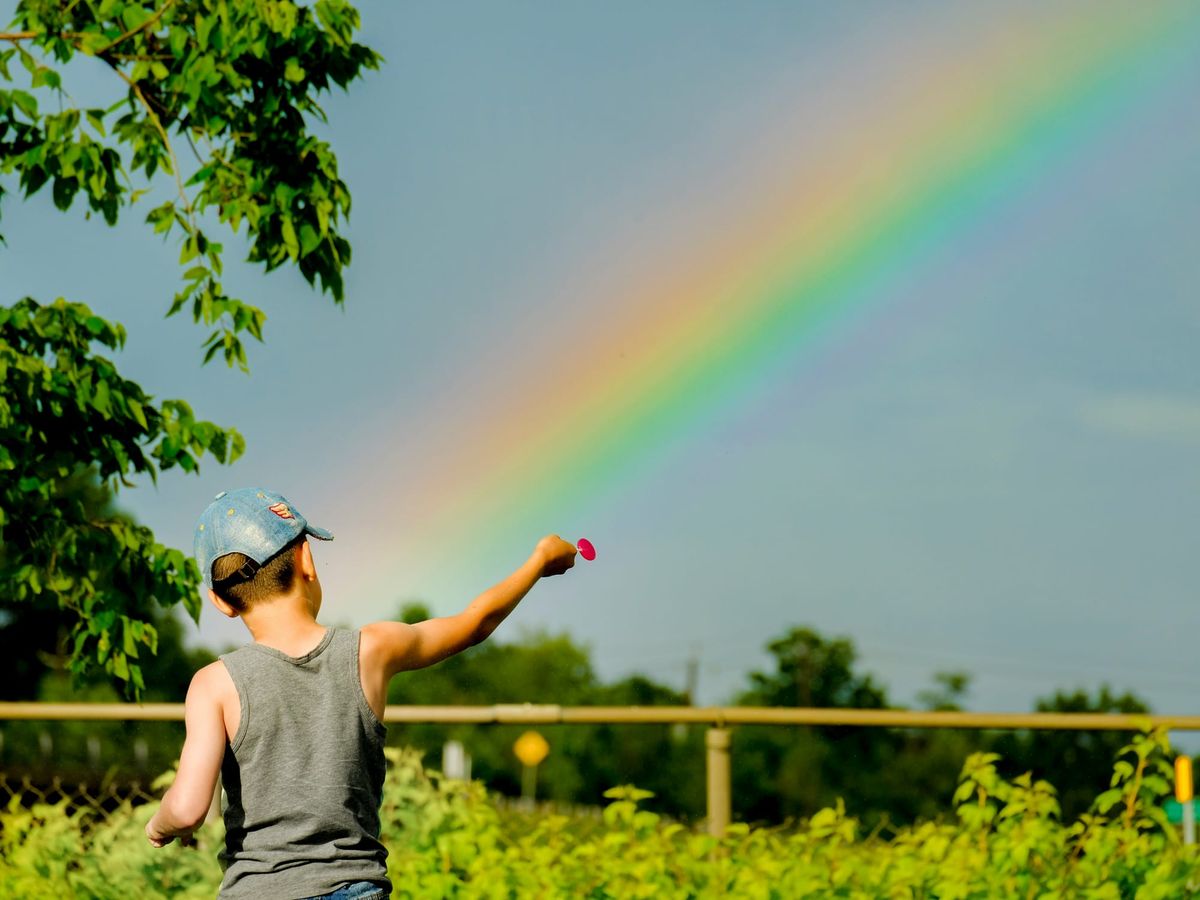
“A great many things will happen to you, but none of
the things you are afraid of. It was the wind in your hair.
The red-winged birds embroidering the blue sky.
That has been your life.”
~Cynthia Marie Hoffman
Most parents start out, often long before their children are even born, holding onto some sort of mental image of what parenting will be like and of who their children will become. We begin conjuring these images, consciously or not, very early—probably even when we are still children ourselves, observing our own parents and creating mental schemas for what it means to be an adult in the life of a child. And, in the months leading up to actually bringing a child into our families, most parents move through ritual after ritual defined by making this mental image ever more precise and concrete.
We develop lists, not only of the things we will need to care for a child, but also of items that allow us to add increasingly fine detail to the picture we carry in our imagination of this person we don’t yet know. We choose colors and nursery motifs and toys and tiny outfits, defining the spaces they will inhabit and the objects they will relate to, almost as a way to manifest the person and the relationship that we’ve cultivated in our mind into being. And we don’t just imagine their earliest weeks and months. We create mental pictures of a lifetime of milestones yet to be. It is often these images that lead us to want to be parents in the first place.
To some extent, this is all inevitable. Caring for children does require preparation, physically, mentally, and materially. And, in whatever way our children come into our lives, there is almost always a period of waiting and anticipation that invites us to envision the future. I do think that these rituals usually have, at their center, a core of love and an understanding of the responsibility that caring for another life will demand. Becoming a parent is a significant transition and one that will ripple through the rest of our lives and through the growth and development of a whole other human. The stakes feel high and they reach across time. Most parents also move through these rituals of preparation with a desire to create a soft landing for this new person they will be responsible for—a safe and nurturing environment that somehow signals our love before words can take shape and carry meaning.
Yet, even in the best possible, most loving circumstances, there is also a risk inherent in all this imagining, as we tuck the vision we’ve created of this yet-to-be-person and their future into our own identities. Ultimately, once there is a real child in our lives, the future starts to take its own shape, day by day, week by week, year by year. And none of it is ever exactly as we’ve imagined. How we respond to the little fault lines between our imagination and reality, as they emerge, can become a defining feature of our experience of parenting and, most importantly, of our child’s metabolization of our parenting.
So much of any human life is defined by determined attempts to control the uncontrollable. This is often amplified in parenthood, as it can feel like our children take a piece of our heart out into the wild and unpredictable world—a terrifying prospect, even when we choose it. We feel their pain as our own and try to anticipate and minimize it where we can. But, sometimes, in attempting to do this, it is that early imagined version of our children we are trying to protect, not necessarily realizing that we’ve conflated our imagination with the real person they are becoming. In guarding that imagined child and the life we’d pictured for them, we can fail to see the real child in front of us. And, when this happens, we limit their own ability to recognize themselves and to believe that we will love and value them, no matter how far they may diverge from that crystal ball mirage we created long before they arrived.

Many of the challenges I’ve supported parents through over the years, as a teacher, have come down to this tension between who they thought their child would be—which can easily morph into who they believe they have the power to shape their child into—and the reality of who their child actually is. The ghost of the child a parent pictured, before a real child existed, sometimes lingers ominously, making a stranger of the child they really have.
Because our children become so woven into our own identities, it is easy to drift, in these moments of disconnect, into a version of parenting defined by seeing our children as property, or as accessories to our own identity, and this is especially dangerous, as I’ve written before. But, even in the most loving, generous, and well-meaning parenting relationships, our ability to let go of that ghost child is essential to embracing the real child before us and, in turn, to giving that child permission to embrace themselves, assured of our unwavering affection.
I sometimes wonder if there could be a way to re-frame all those rituals leading into parenthood, so the focus was less on preparing for an imagined future and more on the anticipation of a life filled with surprise. If we could ritualize our entry into parenting as a transformative period, marked by the delight of lifelong discovery, instead of by the expectation that we execute a predetermined vision, perhaps we would be less afraid of the unknown and more able to find pleasure in our children’s gradual emergence.
Fundamentally, parenting is at least as much about getting to know our children as it is about shaping them. And the more we attempt to hold our children within the version of reality we pictured before they existed, the more we risk constraining their own ability to imagine a future for themselves, or to see themselves as worthy sculptors of their own vibrant lives. It is often how we react to the surprises children offer us that matters most. The more experiences we share with our children of our joy at discovering who they really are, rather than our pride at their alignment with our expectations, the more likely they are to feel confident revealing themselves to us and to the world.
Of course, there are ways in which parenting is about guiding and shaping our children. But perhaps it’s useful to make a distinction here between guiding our children in how they engage with the world and attempting to control who they will become. We can model and encourage values of interaction—kindness, perseverance, and honesty, for example—even as we commit to listening to them and to embracing what they share about who they are and how they want to be known.
I think often of the journalist, Sandy Ernest Allen, who has written of growing up trans, surrounded by people and cultural messages that told him that what he knew of himself was somehow both impossible and wrong. He writes of his younger self, “I know how much nobody ever listened to him. I know how much nobody ever told him: I see you exactly as you are.”
I’m always struck by the simplicity of his reflection, because it could be so easy to offer this to every child. To listen to a child and to allow them to show us who they are should be the easiest, and even the most joyful, obligation of parenting. What a gift it is to get to bear witness to the emergence of a whole new person. And yet, we often present children with our own imagined versions of who we thought they’d be, and expect them to shape shift into the embodiment of that ghost, instead of delighting us, and themselves, with all the surprises that self-discovery entails.
In his essay, Nothing Personal, James Baldwin wrote,
“The longer I live, the more deeply I learn that love — whether we call it friendship or family or romance — is the work of mirroring and magnifying each other’s light. Gentle work. Steadfast work. Life-saving work in those moments when life and shame and sorrow occlude our own light from our view, but there is still a clear-eyed loving person to beam it back. In our best moments, we are that person for another.”
What if we were more able to see parental love in this way, as a commitment to look for the spark that makes our children most themselves and to magnify that light for them? Surely, our ability to do this for our children doesn’t have to conflict with our responsibility to guide their development. In fact, I’m not sure what meaning our guidance can have, if it isn’t rooted in first seeing them for who they really are.
I recently stumbled on an old video from Mr. Rogers’ Neighborhood, in which Daniel Tiger (the original scruffy puppet, not the newer bright orange cartoon) confesses to Lady Aberlin that he sometimes feels like “a mistake” because he knows how different he is from all the other tigers.
Daniel sings,
“Sometimes I wonder if I'm a mistake.
I'm not like anyone else I know.
When I'm asleep or even awake,
sometimes I get to dreaming that I'm just a fake.
I'm not like anyone else.
Others I know are big and are wild.
I'm very small and quite tame.
Most of the time, I'm weak, and I'm mild.
Do you suppose that's a shame?
Often I wonder if I'm a mistake.
I'm not supposed to be scared, am I?
Sometimes I cry, and sometimes I shake,
wondering, isn't it true that the strong never break?
I'm not like anyone else I know.
I'm not like anyone else.”
Of course, Lady Aberlin reassures Daniel that she loves him for exactly who he is and who he is becoming. In the gentle context of Mr. Rogers’ Land of Make Believe, this seems the obvious and natural response. But we frequently fail to deliver this message to children, or even to see their doubts and their worry and to realize that what they need most is our unabashed reassurance and our unwavering delight at who they are—their light beamed back at them.
In Joseph Fasano’s poem, “Why Open?” he writes simply,
“Because what is a blossom
anyway
but a fist saying
I can’t
do this
anymore”
What if every child, who didn’t feel they fit or wondered if they were a mistake, was met with delight at the surprises they held within themselves, instead of with anxiety or disappointment or disapproval? What if we entered parenting eager to witness the unfurling of unseen petals, instead of hoping for the arrival, in embodied form, of someone who only ever existed in our minds’ eye?
And what if we all offered this same delight and magnified illumination to children who aren’t our own? What unknown pleasures and opportunities might become available to children and to us?
I hope you'll think about how you might do this for the children in your own life.
Wishing you love that delights in discovery,
Alicia
A few things I found helpful and hopeful this week…
- Mourning the Trans Boyhood I Never Got by Sandy Ernest Allen - This is the essay quoted in this week's note. I hope you'll read it in full.
- I discovered the clip from Mr. Rogers' Neighborhood, because The Fred Rogers Company is making all of the episodes of the show available for free!
- Why being a NYC librarian can mean being a social worker
- Pride, Birds, And the Beauty of Survival by Erin Reed
- Former anti-vax influencer now provides support to parents deciding to vaccinate